Ecosystem would have to be one of the most popular tabletop games within the gameschooling community. It is the perfect game for general play while being super-considerate about educational properties and environmental issues. The only way they could top it would be if they somehow expanded the game to include other ecosystems… Wait a minute! THEY DID!! While the original Ecosystem feels inspired by the majestic forests of Europe, there are now two extra ecosystems to play. Ecosystem: Coral Reef and Ecosystem: Savanna. Now, Savanna is relatively new on the market; so new, I haven’t been able to put my hands on it just yet. However, I have played Ecosystem and Coral Reef extensively, and I’m here to give you the rundown on each game, individually and comparatively.

What is Ecosystem?
Let’s start with the original. Ecosystem is a tabletop game designed by Matt Simpson and developed by Genius Games with art by Lindsay Falsone. Gorgeous art, by the way. Simply gorgeous. But I digress. This card-drafting game requires 2-6 players over 14 years, but we only consider the age reference as a suggestion. EG Zaltu has been playing this game since I brought it home from PAX Aus 2019. She didn’t start as strategically ruthless as her brothers, but she has picked up the spirit of the game.
The idea of the game is to build your own ecological network within the ecosystem based on the cards you draft and move around the players. Each player takes their turn simultaneously, choosing a card from their hand to place in their ecosystem before passing their hand to the next person. A single game is played across two halves, each with ten (10) cards in play. On average, playing a full game takes 15-20 minutes. There are rules to guide the placement of each card, granting points for ideal placements and rewarding players who work with a diverse ecosystem (rather than favouring a single high-scoring card). The game ends when players place the 20th card in the ecosystem, and the winner has the highest point score.
What’s in the Box?
All of the Ecosystem games come in compact little boxes with the following components included:

- 130x cards, including:
- 12x Foxes
- 12x Deer
- 12x Bears
- 20x Streams
- 8x Eagles
- 8x Bees
- 20x Meadows
- 12x Wolves
- 10x Trout
- 8x Dragonflies
- 8x Rabbits
- 6x Player Aids
- 1x Scoreboard
- 1x Rulebook (double-sided single-sheet)
As a card-drafting game, the main components are the cards. The euro-size cards may seem small and flimsy at first, but they are printed on durable glossy cardboard that has lasted at least four (4) years in our house (and still counting). When you start holding ten (10) cards in your hand, the smaller size is a great fit, even for my truck-o-Saurus hands! The illustrations help by providing enough detail to see the features on smaller cards. Shuffling can be a little problematic, so I suggest doing it in batches.
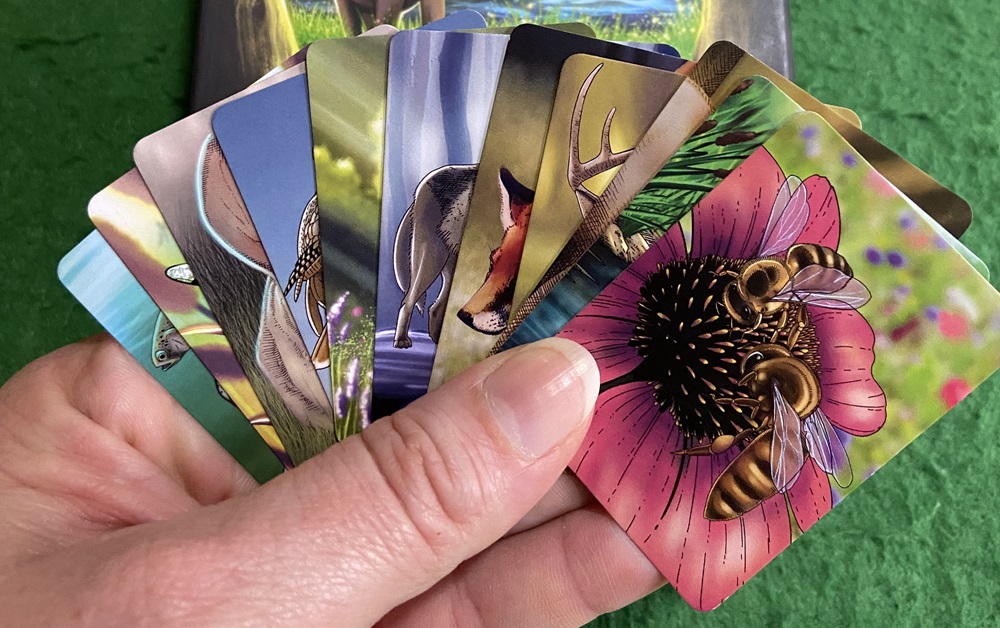
Back to the illustrations because they are so beautiful! Lindsay Falsone has done a fantastic job capturing the realism of the environment, allowing the cards to breathe without any need for text. This is also seen in the Player Guides, balancing simplicity and beauty while still providing much information.
When we first received Ecosystem, I was worried the lack of packaging support inside the box would damage the cards. Years later, I am happy to say the cards still look fabulous, even if they tend to slide around a lot. Internal packaging is one of the hardest things to do right with tabletop games. And while I wish there were more support for the cards, the minimalist approach still works well for this game.
How to Play Ecosystem
- Each player is given a Player Aid in front of them. Ensure each player has enough room for a grid four (4) cards high and five (5) wide.
- Shuffle the cards and deal ten (10) cards to each player.
- Players may look at their hand but not at anyone else.
- During each turn, players will perform four (4) actions simultaneously.
- Choose one (1) card and place it face down in front of you on top of your player aid.
- Pass the remaining cards to the player on your left, placing face down beside their player aid.
- Once all players have selected their card, reveal your chosen card.
- Place the chosen card into your grid adjacent to another card (touching on at least one side of the card, horizontal or vertical but not diagonal)
- Continue drafting until the last card is passed.
- Repeat steps 2-9 for the second half of the game, except this time, cards pass to the player on your right.
- At the end of the second round, all players should have a grid of 20 cards in front of them.
- Using the scoring pad, calculate the points accrued for each category. Multiple points can score off the same card. For example, two different Bear cards can score points off the same Trout card.
- The winner is the player with the most points!

At first glance, it looks like a really simple game. That’s why it is such an excellent game for kids! It’s easy to pick up without being over-complicated with the card placement. However, as more cards add to your grid, you begin to see the strategy required for ideal placement. You can play this game with older kids and adults with very different results.
Ecosystem: Coral Reef – Same Game or Different?
As mentioned at the beginning, Ecosystem has introduced two new environments: Coral Reef and Savanna. It’s still the same card-drafting mechanic with a 20-card grid placement, but there are a few subtle differences between the cards and the point-scoring system.
What’s in the Coral Reef?

- 130x cards, including:
- 12x Coral
- 20x Krill
- 20x Plankton
- 10x Grouper
- 14x Clown Fish
- 12x Crab
- 8x Eel
- 8x Shark
- 6x Whale
- 12x Turtle
- 8x Octopus
- 6x Player Aids
- 1x Scoreboard
- 1x Rulebook (12pg booklet)
How to Play Ecosystem: Coral Reef
The gameplay is the same for both games: Choose, Pass, Reveal, Place. It is still the same 20-card grid, and you are still encouraged to build a diverse ecosystem with points awarded across each category. There is, however, one distinct difference between the original and Coral Reef.
In the original, players are penalised for lacking sufficient diversity across their ecosystem. During the final scores, each player will note a zero next to the animal/environment card they have not included in their ecosystem. If you have four (4) ‘zeroes’, you deduct 2-points. Six (6) or more zeroes will penalise you 10 points. It’s a good reminder of why diversity is essential.

Coral Reef has a different feature in its point scoring. Instead of the penalty system, Coral Reef draws your attention to the food chain within your ecosystem. Most cards in Coral Reef are divided into three (3) groups: Producers, Prey, and Predators. The two cards not included are Turtle and Octopus. At the end of the game, players count how many cards they have from each of the three groups and receive a Food Web bonus equal to the lowest of their tallies. Once again, you are encouraged to include as many different cards as possible in your ecosystem, but with a bonus rather than a penalty. It’s a subtle but distinguishing difference when you think about the environments you are dealing with. The Food Web is far more noticeable in the Reef environment than the forests, especially when food isn’t as strong a feature in the original game.

Why Ecosystem is Top of the Gameschool Pyramid
It is no exaggeration to call Ecosystem one of the most popular tabletop games for Gameschooling (for more on the Gameschooling experience, read my earlier article here). It’s hard to find tabletop games that fit within the science syllabus, balancing accuracy with entertainment. Ecosystem (and its variations) has found the balance and provides an instantly replayable game.
The core learning experience is building an ecosystem. It starts way back in primary school (elementary school), in the Living World component of Science studies. Here is where students first learn about the interrelated experience of animals, food, and habitat. As they progress, students will continue to revisit ecosystems. For example, the NSW (Aust) syllabus includes how environments and living things are interdependent within the Stage 2 Science syllabus. In Stage 3, students learn how changing physical conditions in the environment affect living things’ growth and survival. In senior years, students will continue to learn about ecosystems in Year 11 Biology and Year 12 Geography.
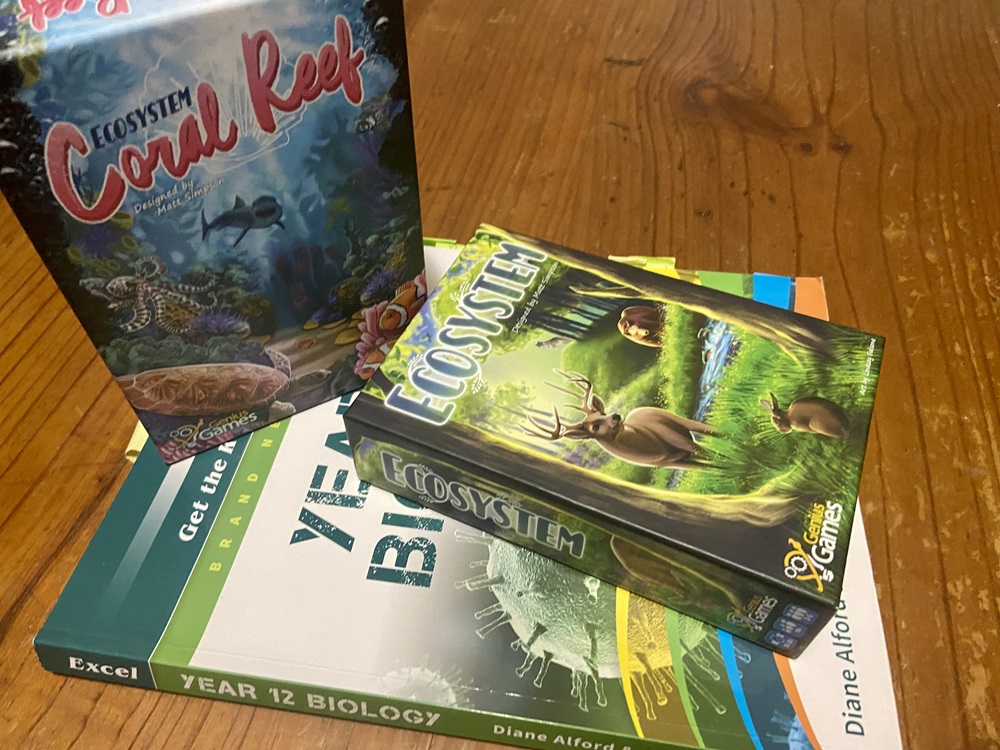
The significant part about Ecosystem is how it doesn’t slam you with the science. It encourages you to think about the larger environment. Each time you play, you are building a new, unique ecosystem. There is no guarantee you will receive every type of card in the deck, and you will see this impact in your final score! The more you play, the harder you strive to hit the perfect balance. We played a few rounds, removing all the bees from the deck. It was our second-lowest scoring game ever; Our lowest was when we took out all of the Streams. This real-world relationship creates a powerful learning experience within a simple yet enjoyable game.
Original or Coral Reef? Do I HAVE to Choose?
As a reviewer, it is expected for me to say BUY BOTH. If you can do so, I would still recommend it. Learning about different environment ecosystems does provide a slightly different experience. Plus, if you have difficult spawnlings like we do, there is always one who wants to play Ecosystem because it has bunnies and one who wants to play Coral Reef because it has the octopus. I’ll probably buy the third one, Savanna, for Solstice because our middle spawnling likes elephants, and I hate to see any ‘middle-child-syndrome’ (yep, I’m soft).
But buying lots of tabletop games is not possible for every family. I get that. So let’s be honest and discuss which one I would prioritise…

Ecosystem: Coral Reef. It’s a tough choice because I love the original, and it was the one to start me on this path of ecosystem discovery. However, the clincher is the Food Web Bonus. While the diversity-penalty is an excellent message to send out to the world, I think the complexity of the Food Web in our oceans needs to be explored, and Coral Reef is a great way to start the conversation. Please note: there is also a little biased opinion here. I grew up on the Great Barrier Reef. Again, I love the forest aesthetic of Ecosystem, but the coral calls me!!
Score: 5 out of 5 super-intelligent octopus. Both Ecosystem and Ecosystem: Coral Reef are absolutely perfect games, and I can’t think of a thing I would change about them. Even the internal storage works, and I can’t think of a better way to do it. Now, I really want to check out Savanna (2023).
Big Thanks to Games Australia for supplying the review copy of Ecosystem: Coral Reef. Big Thanks also to Genius Games and their spectacular range of science tabletop games and paraphernalia. The team at Genius Games understands the wonder of science and knows how to bottle it, I mean, box it for entertainment. Visit their official website here, and tell your local game store to contact Games Australia/VR Distribution for more Genius Games.
Categories: Curriculum of Evil Gameschooling

Evil Genius Mum
Evil Genius Mum
- Taking over the world, one blog post at a time
 Evil Genius Mum
Hi there, EGM! My name is Matt Simpson and I created Ecosystem. My wife sent me the link to your review, and I was so happy to read it. I am even more happy that you and your kids are enjoying the games and getting so much use out of them!
Just in case you’d like any behind the scenes information I will share a few comments about points you made in your review:
Card size – I desperately wanted to make the cards standard sized. In fact, all early prototypes of the game were 2.5 x 3.5 sized. However, in a six player game the grids became incredibly sprawling and took up a ton of real estate. Ultimately, because of the aforementioned reason and printing costs I decided on the smaller cards.
Educational Tool – I have to say that this is the first review I have ever read that mentioned using the game exactly how it is intended. It is supposed to not only be a critical thinking exercise and strategically fun experience, but a conversation starter for things like the food web, the differences between carnivorous/omnivorous/herbivorous animals, and ecosystem diversity.
Box Insert – Before I met the amazing people at Genius Games I was intending to self-publish Ecosystem. My thoughts initially, once I reached the printing phase, was that the smaller card size I had landed on allowed for a smaller box that would contain the cards well enough. I had hoped that this would suffice to keep the cards in place well enough that setup would not be adversely affected. I do agree that an insert would have been nice, though.
Artwork- Not much to say except that Lindsay is a rockstar. In fact, the original design for Ecosystem wasn’t about ecosystems at all, but was instead sci-fi themed and the original grid was supposed to represent spaces for trade ships, asteroids, space stations, supply lines, and the like. Lindsay’s art, when I saw her drawing in the local board game store, made me rethink the theme of the game completely. I forget now what she was drawing that inspired me so, but it was something nature related and it was beautiful. I re-themed the game after talking to her. She is amazing.
If you haven’t picked up Savanna yet, I’d love to send you a free copy. Let me know, because I have a lot of copies. My wife buys them every time she sees them in a new store, not realizing that the money spent for the game far outweighs my royalty for said copy. I’m pretty sure that she is buying at least 50% of the U.S. copies of the games sold each year.
Thank you again for the review. It made my night!
Matt
LikeLike
Hi Matt!
It made your night?! THIS made my night!! I absolutely love when game developers share cool info about their game development. Especially for the indie developers. Your explanation about the card size is greatly appreciated, and definitely explains a lot. And box insert design is the bane of all game developers – it’s a fine line between providing the storage and keeping the game at an affordable price.
I love the idea of ECOSYSTEM as a space-themed game. It sounds a little similar to LUNA BASE, a 2021 TT card game published by Plepic Games. It’s a fave in the EG Lair, and I’m overdue for a review of it. Both LUNA BASE and ECOSYSTEM have a similar research-centric approach and encourage forward thinking.
I can’t really speak on behalf of the gameschooling community, but I think most would agree with me: THANKYOU so much for ECOSYSTEM. It has become one of the most popular games recommended for both educational and entertainment use. And sure, your wife (in all her wonderful supportive ways) may drive sales of the games in the USA, but I reckon I’m responsible for at least of a third of all sales in Australia–it’s our go-to present/prize for gaming conventions, birthday presents, and end-of-year gifts for school teachers. 😀
LikeLike
That is just beyond amazing! Thank you for being such a champion of the Ecosystem games! I hope you get many, many more years of enjoyment out of them. You seriously rock, EGM!
Matt
LikeLike