A masterclass in comic journalism for a nation of people still waiting to be seen.
Prelude
Once again, I find myself delaying my review of Joe Sacco’s Palestine due to very recent and very local events. Earlier this week, I attended a rally in Sydney (Australia), protesting against Israeli President Isaac Herzog’s visit here. To be clear, the Independent International Commission of Inquiry on the Occupied Palestinian Territory named Herzog as having incited genocide against the Palestinian people. This is the guy who was photographed signing bombs prior to attacks on Gaza. This is also the guy who stated there were no civilians in Gaza, thus encouraging Israeli military forces to use excessive force on all Palestinians. Yes, this is the guy the Australian Government invited to come visit, to grieve with the Jewish victims of the Bondi Shooting in December 2025, at the expense of trauma to so many others.
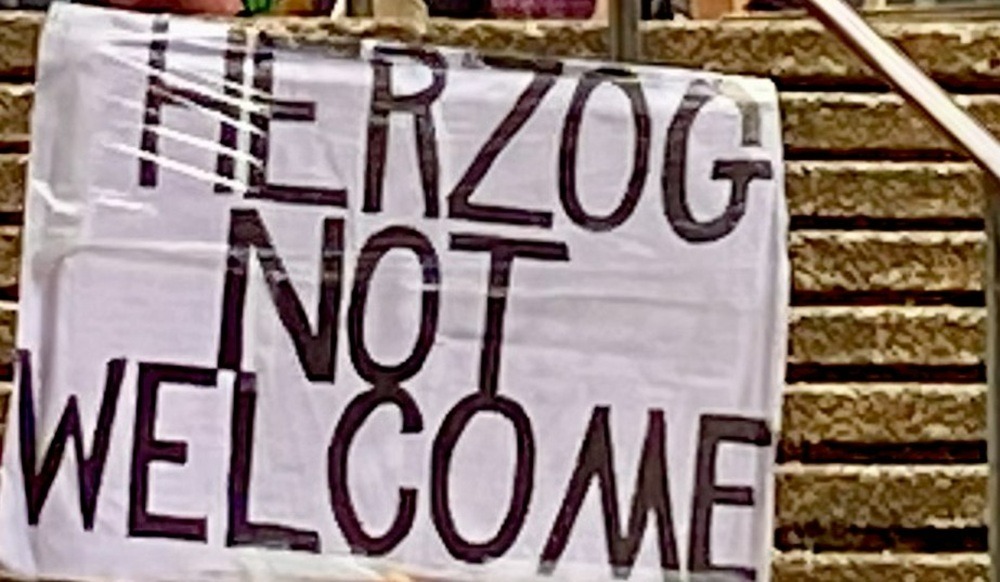
This is the guy the Australian Government wanted to laud about Australia, and use to bring “social cohesiveness” to Australians. And thus, I “socially cohesed” at the Sydney rally with 30,000 people to tell the Australian Government this is a bad idea. I will not interfere with anyone’s right to practice their religious faith, be they Jewish, Muslim, Greek Orthodox, or anything else. However, political leaders who incite genocide are not welcome here. There were multiple protests across Australia at the same time, all chanting the same thing: “Herzog to the ICC.” Because that would be Australia’s responsibility as a party to the Rome Statute.
So, forgive me for the delay with my review. It took a little time to collect my thoughts on this serious and confronting topic. And if I thought it would make a difference to send a copy to the Australian Prime Minister and the New South Wales Premier, I would do so.
Maybe they’ll just read my shorter review here.
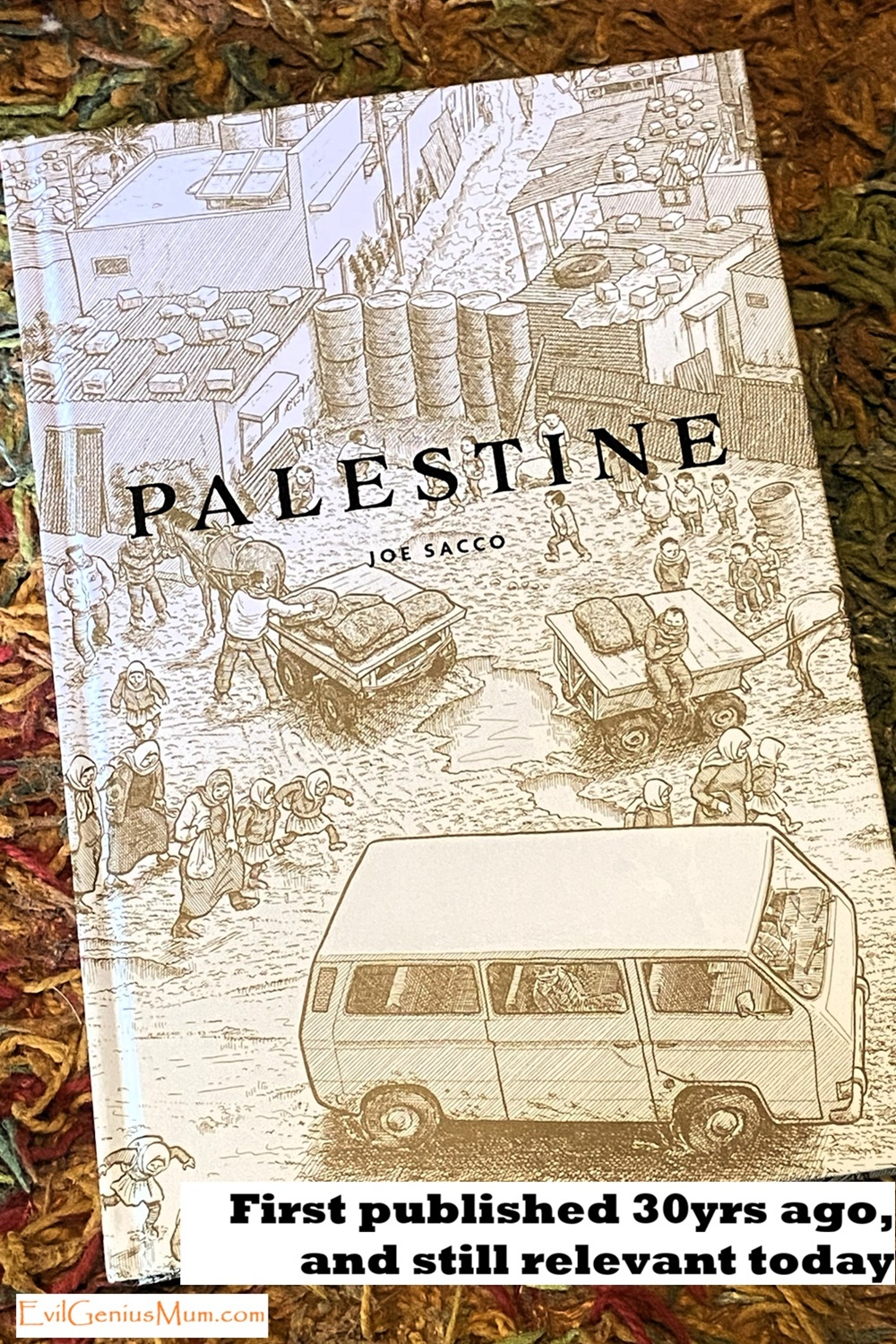
Palestine by Joe Sacco: Another comic book?
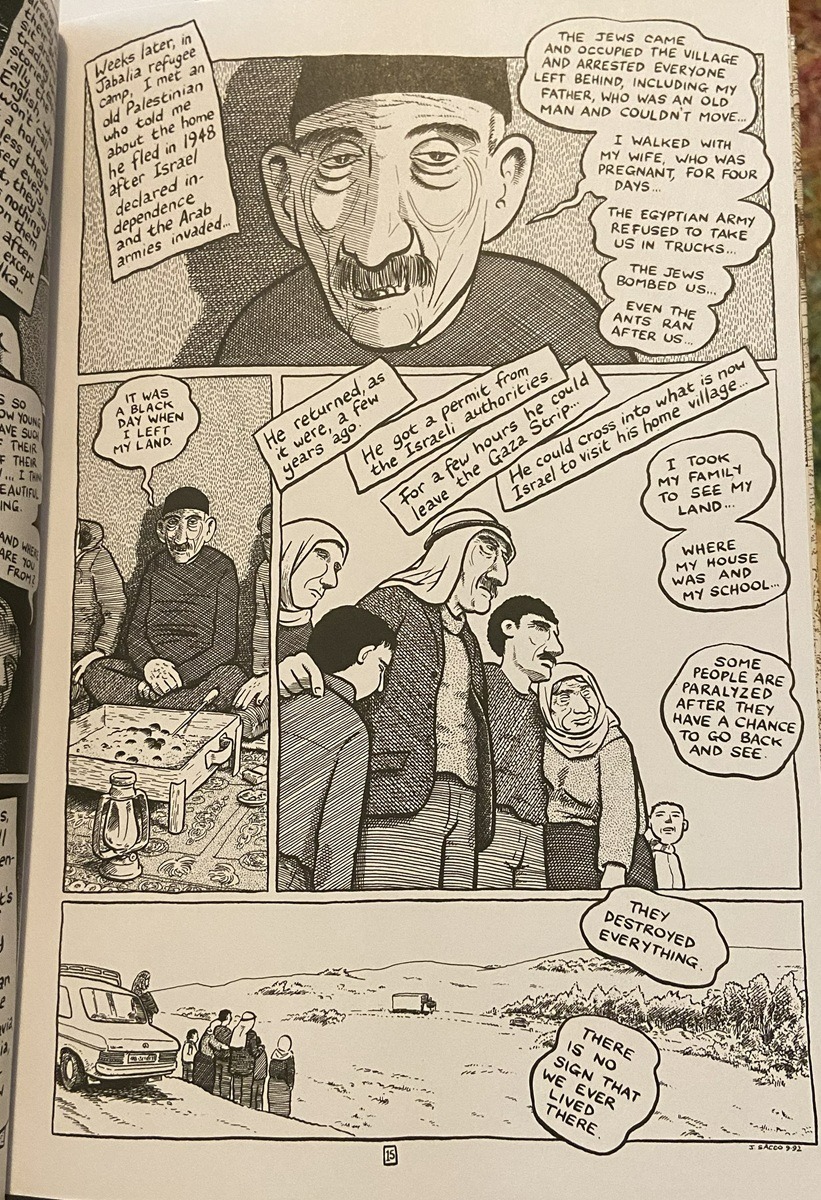
In 1991, Joe Sacco visited the Occupied Territories of Palestine for perspective. Sacco was an investigative journalist, raised in the United States of America in a very Catholic Maltese family. Like many, he grew up thinking Palestinians were either terrorists or victims. There was very little opportunity to see them as anything else. Sacco’s journalistic mind wanted to challenge this; he was determined to visit Palestine and see for himself. Over a two-month period towards the end of the First Intifada, Sacco visited multiple families, collecting first-person accounts, and giving a voice to people who didn’t think anything would ever come of it.
Sacco’s chosen medium of comics was deliberate. As commented in an interview with The Comics Journal, Sacco’s artistic style brings a ‘bracing shock of honest reality’. He has always been a cartoonist first, though he is also interested in political matters. Palestine is a beautiful example of this, showcasing the people in their own homes and villages rather than just the political situation. It’s important to note this difference. Sometimes, the journalist seeps through in his storytelling. But the cartoonist is always there.
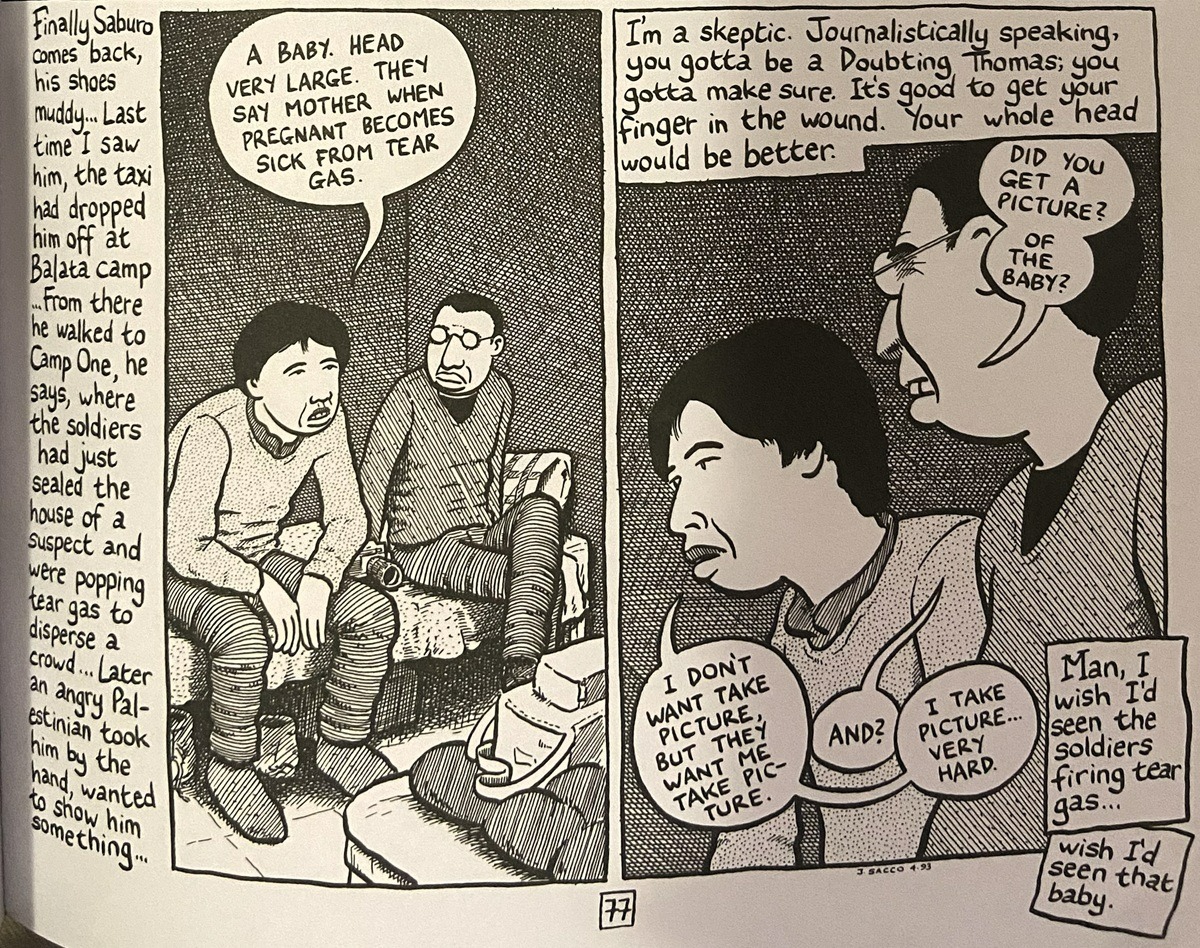
With a Journalist Eye
Don’t be misled by the above picture. Sacco’s self-portrayal is a bit of a mirror held up to the Western World. His over-eager journalist image is a reflection of our own eagerness to ‘observe’ Palestine, albeit most of us aren’t as eager to actually go there and get our hands dirty. In fact, mainstream media tends to be driven by the most dramatic stories: “Man, I wish I’d seen the soldiers firing tear gas… I wish I’d seen that baby.” That drive to find the next provocative story, the next emotionally charged image. It is the ever-evolving tactic of every news service, pushing the boundaries and chasing whatever it takes to capture your attention. Sacco’s storytelling is constantly balancing this perspective with his relationships with Palestinians. Every panel is a shared story of yet another Westerner wanting to tell the story but not truly hearing it.
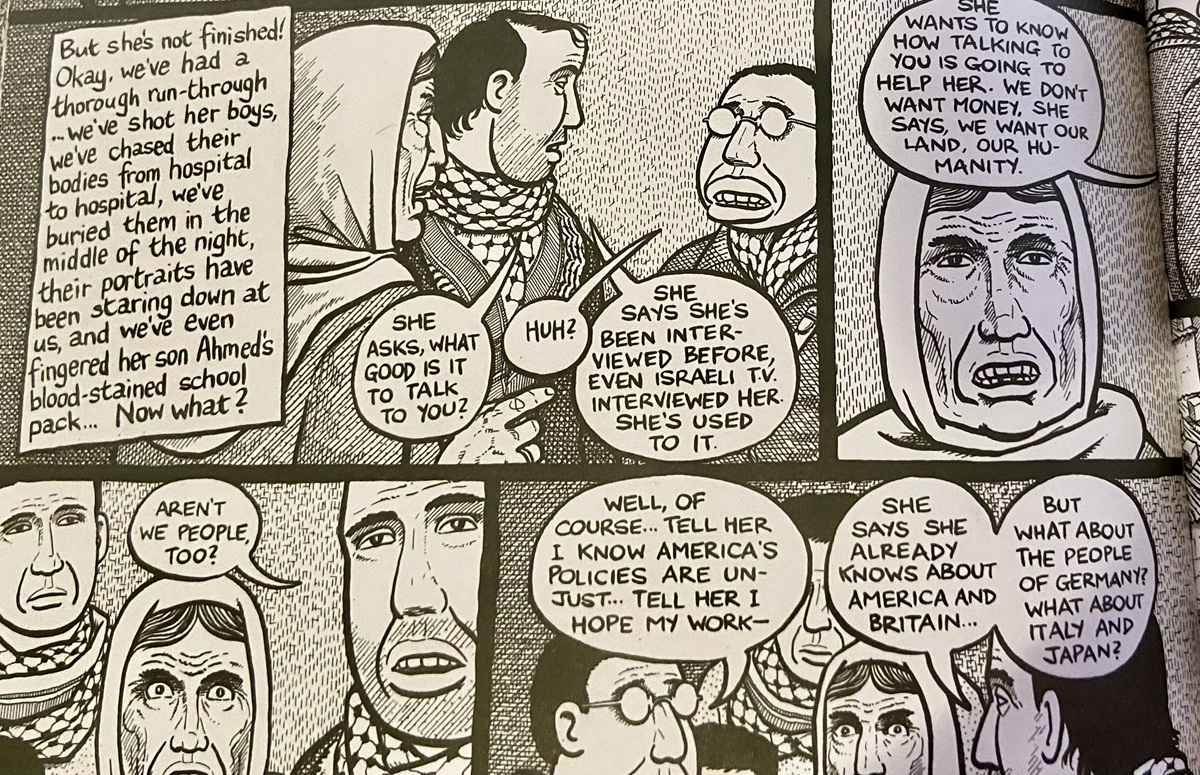
To be fair, at first I struggled with Sacco’s narrative style: it portrays the objectivity expected of a journalist while delivering an undercurrent of emotional impact in the stories. I read Palestine too soon after reading The Complete Maus by Art Spiegelman (my review is here), and did not appreciate the dichotomy of Sacco’s delivery. Both Spiegelman and Sacco wrote themselves into the narrative, both simply reporting what they are told. But where Spiegelman’s narrator is clear in his emotional burden, Sacco’s is more subtle. Every retelling of Palestinian life leaves a personal impression. It is more than the story; once again, it is how the story is told. Sacco shares how each person interacts with him, not just with words but through his illustrations. In some ways, it demystifies the objective view of how journalists are meant to report on Gaza and Palestine. Instead, Sacco shows how Westerners watch the news and what they are not seeing at the same time.
The Power of the Understatement
Palestine breathes life into its people and culture. It is not a book I would recommend reading in one sitting; some scenes need a moment to pause and process. There are others with a subtle throwback to earlier cells, reminding us of the continuity and consistency of these reports. Never in a blunt or forceful manner. Every story is told with a certain understatement that, ironically, makes a greater impact. Beyond the opening chapter, which briefly revisits political history, the rest of Palestine is filled with stories of people simply living their lives.
Sacco is eager to point out little things: like, tea. So much tea. And tea with sugar. So much tea with so much sugar. It’s a part of life, and a small detail that centres that moment in both culture and daily life. Again, it’s the understatement. The ability to show some normality of life. There is enough political and religious debate in the daily news. Instead, Sacco takes the time to show what the Palestinians are fighting for: the right to live on their own land. The right to exist. The acknowledgement that they are there.
Why You Should Read Palestine, Especially After Maus
In Sacco’s own words: “Putting out a new edition of Palestine at this moment is hardly a cause for celebration. It is a book that is both out of date in its details – to be expected for a 30-year-old piece of journalism – and, sadly, all too relevant in its general scope.”
There’s a certain power in reading a book specifically noted for its age, yet feeling the relevance in today’s social climate. It’s not a good power, but it’s definitely there. Palestine holds your hand as it takes you down the laneways of Gaza. It nods politely while the people bring you into their lives. It offers you a cup of tea while their words slowly settle in your heart. There is no guilt or shame for the stories. You are not to blame simply for reading the books. However, there is the lingering question of what will happen after you finish reading. Will you return the book to the shelf, claiming that you now understand the War in Gaza? Many in Gaza would never dare to claim that themselves. Will you attend protests? Will you look closer at the images and stories shared by news services around the world?
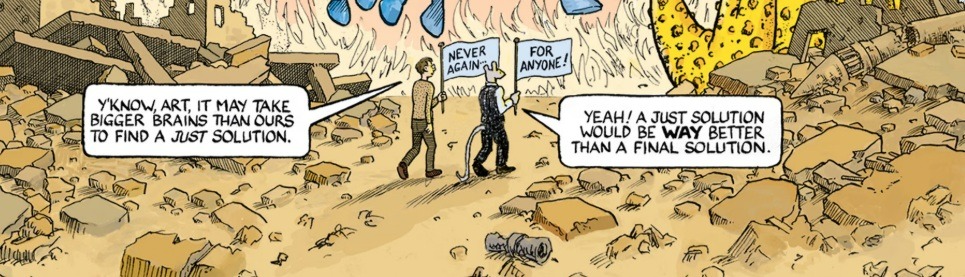
Palestine is absolutely worth reading right now. Would I give it to the spawnlings to read? Absolutely. But not in one sitting and not without some discussion along the way. Sacco’s subtlety is more powerful than many other books on the same topic, in a way that lingers and makes you think. As mentioned earlier, if I could afford to send a copy to Australian Prime Minister Albanese and NSW Premier Minns, I would. The best I can offer is a link to a cartoon featured in The Guardian (Feb 2025), co-created by Sacco and Spiegelman. For the TL; dr…
Categories: Book Reviews General Evil Genius

Evil Genius Mum
Evil Genius Mum
- Taking over the world, one blog post at a time
 Evil Genius Mum
Minion Musings: