Ticket to Ride is one of those games I can pull out at any moment, and know it’s going to be a great game day. It’s my comfort game. My go-to when introducing family and friends to the world of Tabletop. A game we play for pure joy or when we need to tick some boxes in the Gameschooling box. Recently, it’s also been The Game to play while being sick. We’re talking weeks of sick, over the school holidays and beyond, with the only person escaping it being the one person who LEFT for a week (not EG Dad–this time). How many times did we play various versions of Ticket to Ride? I honestly can’t answer that. And yet, it remains a firm family fave. It’s so good, they have made a series for the game. For newcomers, it may be a tad difficult to know which version is the best. Not only am I going to break it down for you, but thanks to Games Australia, we have an awesome giveaway for my favourite.
Ticket to Ride: The Original
This is quite the debate in tabletop communities: Which Ticket to Ride is the Best? Do you start with the original, a well-deserved classic in its own right? Or do you seek out one of the variations to suit your own interests? And while we’re at it, exactly WHY is the original so great?
Ticket to Ride (TTR) is known for its railway theme, with the original based on the US rail system circa 1900. The game is played out on a large map of the USA and the southern edge of Canada. Train routes are shown with various numbers of train cars between major cities, each path in one (1) or two (2) colours. The goal for players is to collect and use train car cards to match with train routes to complete their Destination ticket. Each player starts with two (2) Destination tickets known only to them and detailing a journey from one city to another.
There is an element of chance with the cards collected, especially direct from the deck. However, there is far more use of strategy as you plan out your route across the country, making use of smaller paths to achieve the big ticket Destinations.
TTR won the coveted Spiel des Jahres for Best Game in 2004, an award aimed specifically at family-style games. This is really a no-brainer because TTR is one of the easiest games to pick up for new players and to play as a family. It is considered the Gateway Game: perfect for showing people what REAL tabletop games are about and either bringing in new players–or at least tempting them away from Hasbro’s Monopoly. Visually, it is also a beautiful game, with a warm colour palette and small shapes within each colour to differentiate for those with colour blindness.
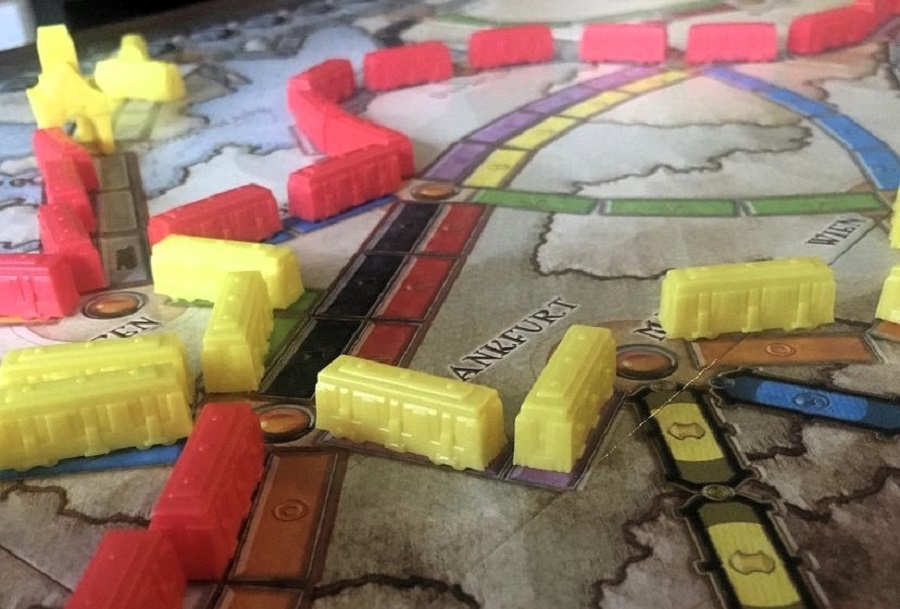
The box says “ages 8 and up”, but I know many families who have played the original version with kids as young as five (5) by simply removing the more competitive nature. It’s fairly easy for kids to pick up the colour-matching aspect. However, those outside the USA may struggle a little with the map. An added bonus for families is the allowance for up to five (5) players, giving a bit more space for a slightly larger family or at least when a newbie/guest comes to visit.
Digital Version
Honesty check: We do not own the original game in its physical format. Instead, we have had the TTR App on our iPad. Unfortunately, the iPad has recently died, and we are very, very sad. Mostly because the main use for the iPad was playing TTR. I kid you not. It was our fave format for the game, and travelled with us on family holidays, including around New Zealand in a campervan. If you thought the TTR tabletop game was easy to play, the App made it even better!

TTR is also available on Steam, opening up a whole range of gameplay with people around the world. I have played with some of my former colleagues at GeekMom/GeekDad and with travel friends in Denmark. It is the kind of game that is universal, making it easy to learn and share without too many language or cultural issues. 5 out of 5, will recommend TTR in digital format.
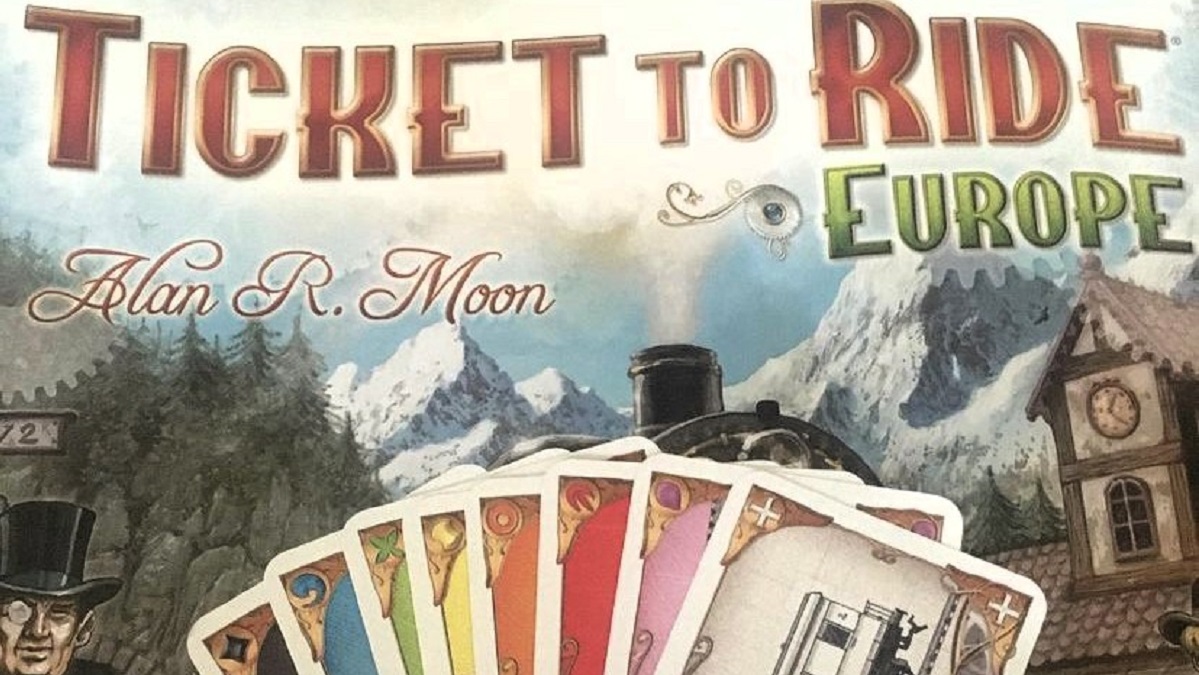
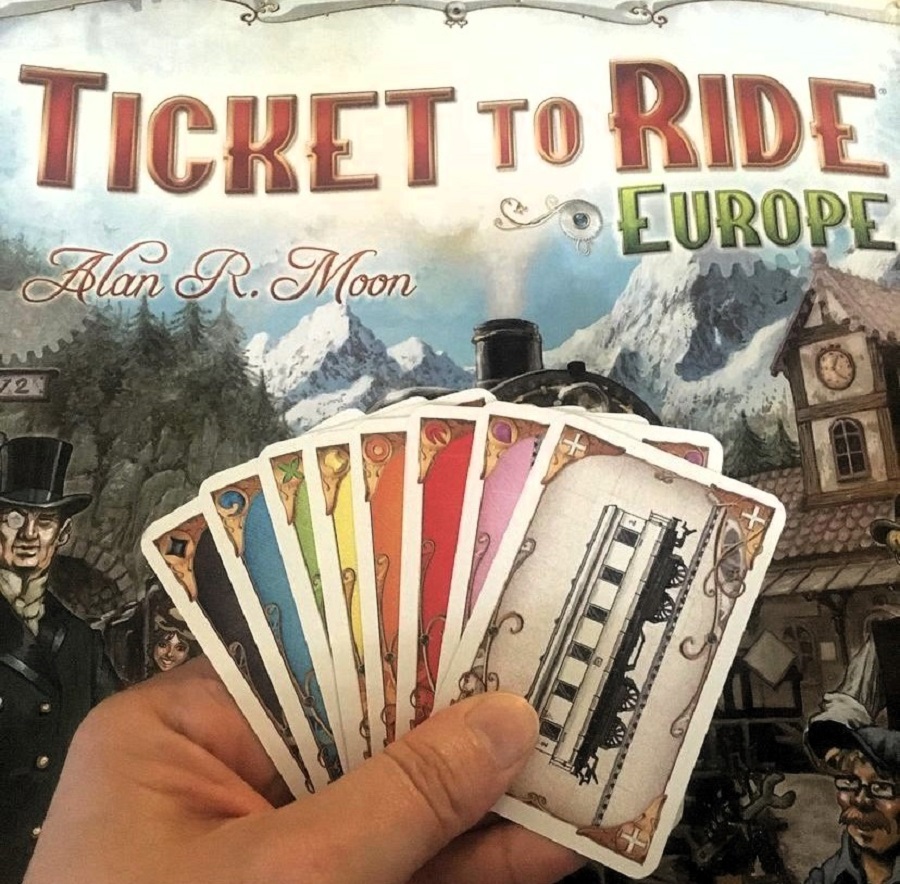
Ticket to Ride: Europe
Naturally, a hit game like this is worth variations. And while the USA is well-known for its historic train lines, anyone who has travelled around Europe will tell you that it is The Place for train travel. I could go on a whole monologue here about train travel in Europe, but we’ll save that for one of my geek-travel posts.
TTR: Europe was published in 2005, a year after the original surfaced. Its main selling point is a brand new map of Europe at the turn of the 20th century. It included two new routes on the maps, ferries and tunnels (fairly common in Europe). This new version also included an extra feature of Stations: allowing players to use a route owned by another player to complete their Destination ticket but at a cost.
One of my favourite things about TTR: Europe is the use of original names for the cities. It makes it a little harder to learn the cities at first, but I really appreciate the respect they give to the local language of each country. And for those Gameschooling, it’s another bonus.
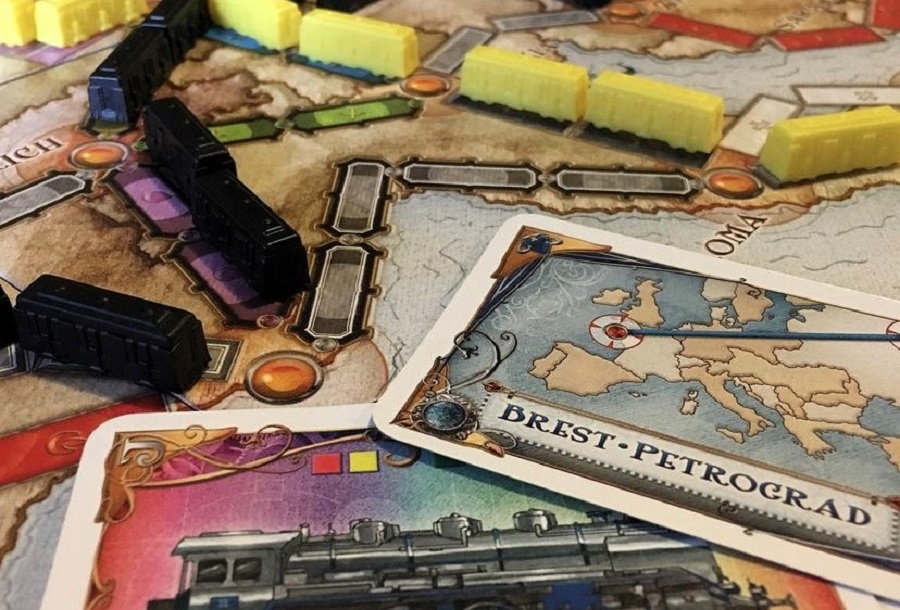
TTR: Europe is also one of my favourite games to have in physical form because it helps with the conceptualisation of the game. Gameplay is still fairly easy, even with the additional features of ferries, tunnels, and stations. However, having the physical stands for the stations is a greater reminder and visual cue for players.
The newer version of TTR definitely opened up the market for possibilities. Following TTR: Europe, there is also Ticket to Ride: Märklin (German), Nordic Countries (a smaller version like Europe), Germany, Rails and Sails, Northern Lights, and First Journey. Rails and Sails was the first version to include a map of The World, including Australia (more on that in a minute). First Journey is the ‘kids’ version of TTR, designed for ages 6 and up. But, as I mentioned above, TTR Original is fairly easy to scale back for kids already. As the kids grow older, you’ll find yourself aging up and out of First Journeys fairly quick. Personally, I would opt for TTR: Europe as a longer-lasting fave in your collection.
Ticket to Ride: Cities Collection
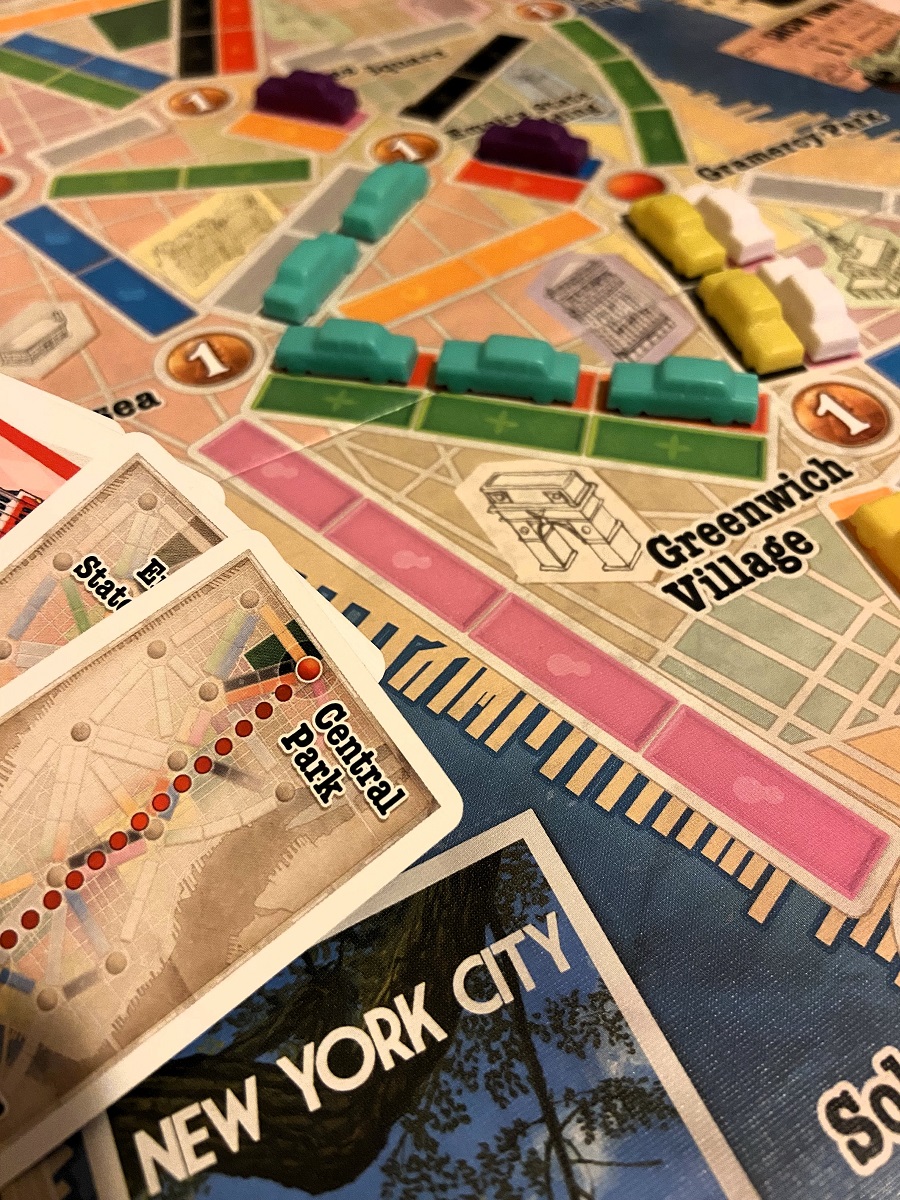
And then there are the quick-fix versions. These smaller games are great for celebrating individual cities, bringing out for a quick game, or taking as a travel version (when you don’t have a working iPad…) While the gameplay is pretty much the same, for each city, the train cars have been replaced with iconic transport connected with the city. The cities included so far are New York (taxis), London (buses), Amsterdam (horse-drawn carts), and San Francisco (cable cars).
Ticket to Everywhere But…?
Can’t see your country on any of the variant games? Don’t worry–there are plenty of expansions… except for AUSTRALIA?! *sigh* I mean, at least we feature on the map for Rails and Sails. New Zealand was completely forgotten! Even Malta missed out on the European versions. And Madagascar is on the World Map but ignored.
So long as you have TTR USA, Europe, Germany, or Nordic Countries, you have all the pieces you need to play any of the following. The expansions come with new maps (often double-sided) and cards, but not the train pieces.
- Asia
- India + Switzerland
- The Heart of Africa
- Nederland
- United Kingdom + Pennsylvania
- France + Old West
- Poland
- Japan + Italy
- Stay at Home – a free-to-print at-home expansion that really helped during the COVID-19 Pandemic Lockdowns.
My Favourite Ticket to Ride game is…
Ticket to Ride: Europe with Rails and Sails a close second.
Part of my love for TTR: Europe is from nostalgia and a certain sense of ‘worldly romance’. I’m sure there is a similar feel for lovers of US Rail history, but I feel like there is a broader cultural spread across Europe. From a strategic point of view, I am also a big convert for the Stations, allowing players to continue their game without feeling blocked out by more aggressive players. Of course, you can always opt not to play with Stations if you prefer.
For Gameschooling, the whole range of Ticket to Ride is a great tool for a variety of lessons. If you own TTR: Europe in its physical form, it is very easy to pick up any of the expansion packs as add-ons. Swapping the maps allows you to adapt to whichever geography topic you are currently studying. You can start with the importance of how to read a map, identifying paths and accessibility between cities. Students can follow the tracks to see how the cities and countries connect across physical distance and even cultural overlaps. Take it a step further and consider how different paths will impact travel; across mountains, through valleys, and bypassing less-populated areas. You can also gain history benefits from the Cities versions, with each game including tourist highlights and cultural references.

There are also ‘indirect’ gameschooling benefits from the entire TTR range. For example, each player is given a limited number of rail cars to complete the journey. You are not allowed to use more cars than you have in your supply; if you reach the last Destination card in your hand requiring 8 cars to complete and you only have 7 cars left, you will have to leave it incomplete and lose points. Math, strategy, and forward-thinking. Excellent opportunity to teach the importance of budgeting. These are skills we ALL need, not just gameschoolers.
The Giveaway
Lucky for us, the team at Games Australia agree: Ticket to Ride is one of the best tabletop games ever made. They also agree that I’m right about TTR: Europe, but they can’t really say that out loud. What they can do is give us a free copy of TTR: Europe to giveaway to one lucky EG Mum follower (it’s the next best thing to a ticket to Europe… okay, the next next next best thing). Big THANKS to Games Australia, who are once again supporting the gaming and gameschooling community in Australia. This is our third giveaway with Games Australia this year, and every time the brief is “How Can We Support Gameschooling in Australia and New Zealand?”
All you need to do is:
- In the comments below, name one country that does NOT feature in any Ticket to Ride game. (Hint: read the article and stop skimming ahead to the Giveaway T&Cs)
- For a Bonus Entry: Head to my Instagram account here and again, comment with one country that does NOT feature in any Ticket to Ride game (feel free to vent your outrage for the game developers there too)
- For ANOTHER Bonus Entry: Follow Games Australia on Instagram here – I’ll be cross-checking their new followers with both my blog and my IG account.
This giveaway is open to Australian and New Zealand residents only. Entries open NOW and close Thursday 10, 2023, at 11:59pm. The winner will be selected at random from the entries submitted as above. I will contact you via email or Instagram direct message. The prize will be sent directly from Games Australia to your address subsequently provided. All conditions comply with the NSW Fair Trading for Promotion Gaming Activity.
EDIT: WE HAVE A WINNER!!
Congratulations to Kristie (IG: @kiweditor)!! You’re the lucky winner of a copy of TTR: Europe. Thanks to everyone who entered our giveaway and shared the review with friends and family. If you are looking to buy your own copy of Ticket to Ride, you can find the original, Europe, and some of Cities selections at various Target/Kmart stores. I spotted TTR: Europe at Target for AUD$49! (No affiliation link) For more choices from the extended range, ask your local tabletop store and let them know they can order from Games Australia.
Categories: Gameschooling

Evil Genius Mum
Evil Genius Mum
- Taking over the world, one blog post at a time
 Evil Genius Mum
Haha, poor New Zealand!
And I’ve never thought about an Aussie expansion. But now I want one. Crazy there isn’t already one.
LikeLike
Australia
LikeLike
New Zealand
LikeLike
Poor NZ does not feature ☹ left off maps everywhere
LikeLike
Australia
LikeLike
How crazy that Australia doesn’t feature on the Ticket toRide games 🙄 and New Zealand too 🤷🏼♀️ thank goodness they are such cool games for all the family to play!
LikeLike
New Zealand
LikeLike
New Zealand
LikeLike
Spain
LikeLike
New Zealand doesn’t feature in any Ticket to Ride game.
LikeLike
New Zealand
LikeLike