When I read the summary for Atiwa, I knew it was the perfect geography tabletop game for any gameschooling library. Geography teaches us how to understand the world around us. It is so much more than maps-and-stats, yet most games aimed at geography are precisely that: location, location, location. Finally, we have a game that is more. Atiwa is a game that builds on relationships between people, animals, and the physical environment. And before you think I’m “bat $*** crazy” for a game about geography, Atiwa is an excellent worker placement game too. But the real icing on the cake: Atiwa can be played with the family or on my own. Yep, I can kick the spawnlings out to the park and practice my world domination on a slightly smaller, rural village scale of things.
Great news: You have the chance to discover the joy of Atiwa yourself. Not only do I have a geography nerd and a geography teacher helping me out with the review today, but we also have a GIVEAWAY!! Thanks to Games Australia, one lucky EG MUM reader will win their own copy of Atiwa. Let’s check out the review first and see how it fits in your tabletop library!
What is Atiwa?
Quick summary: Atiwa is a tabletop game designed for 1-4 players using turn-based claim action and worker placement for resource growth. Or, in fun words: you take turns collecting resources, train up your people, and use the local bat colony to achieve more resources. You gain points if you find the balance between a sustainable environment and village growth.
The game is inspired by the true story of a local king in Kibi, a town in southern Ghana. The king granted sanctuary to a colony of straw-coloured fruit bats residing in his garden. The king recognised the fruit bats’ important role in maintaining a sustainable environment. Fruit bats fly from sunset to sunrise for food, often found in fruit trees 90km away. Along the way, they poop out seeds that can reforest an area of up to two thousand acres annually. This is the soul of geography: learning about the environment and how all the elements interconnect. You can learn more about Kibi and bat conservation here. There is also a small book included with the game, providing more information about the village Kibi and a lot of fantastic geography information behind the game’s development.
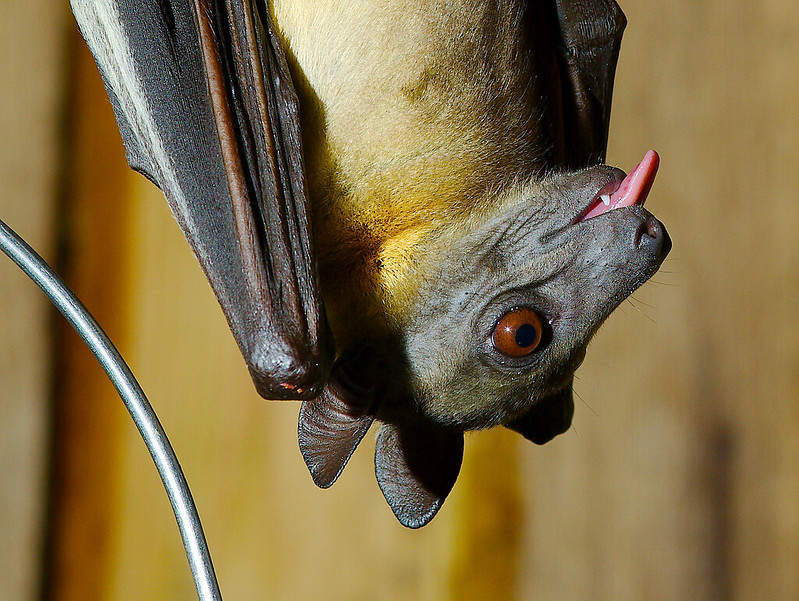
Atiwa works off a very similar principle. You aim to develop a small community near the Atiwa Range (an actual region in southeastern Ghana). You are to build housing for new families, train them to farm, and protect the nearby fruit bat colony. You also need to acquire new land, and manage the farm animals and resources, all while helping your village to prosper. At the end of the game, you receive points for meeting your goals and attaining valuable resources. The player who balances the needs of the village with the needs of the environment wins!
NOTE: Atiwa deals with some pretty big geography topics, including sustainable farming, food distribution, and wildlife conservation. It is also a long game, with average play-time being 30mins per player. While the game is aimed at 12 years and older, parents/carers can judge the suitability for both educational levels and attention spans. Personally, I like playing the game solo, but we’ll get to that shortly.
What’s in the Box?
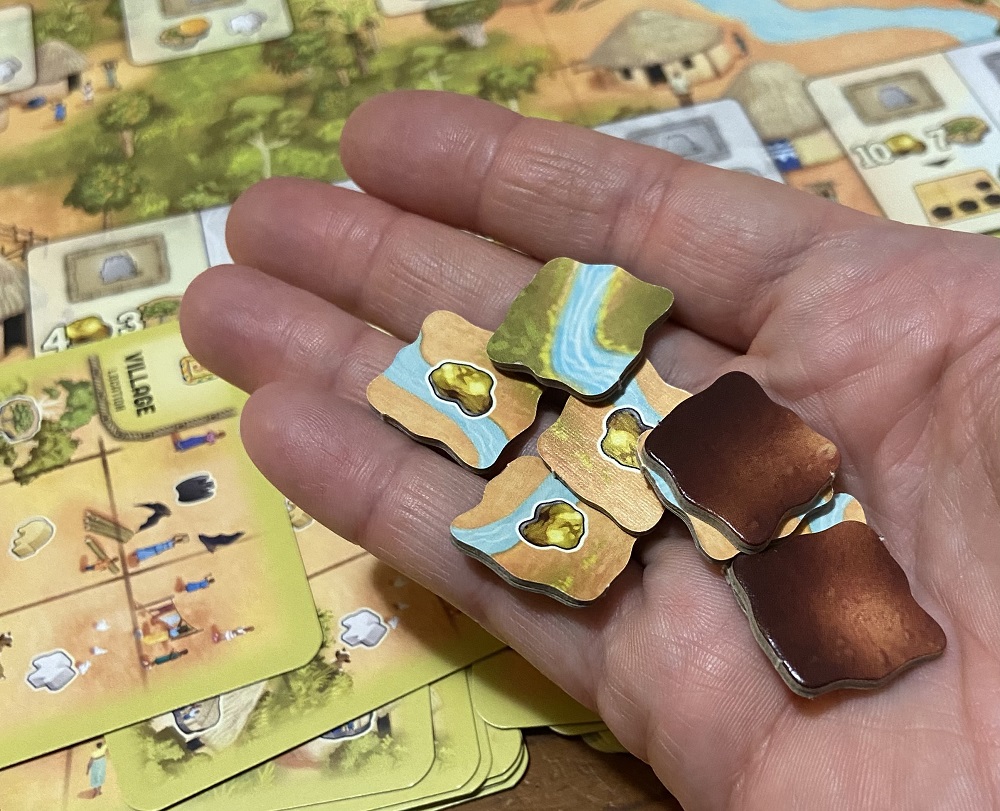
I was blown away by the level of detail and quality of all components. It’s a hefty box with a lot of pieces; I think the only thing I would want more would be a better sorting system for internal storage. But to be honest, I’m not sure exactly how that would be achieved. The components alone make this a high-end tabletop game worth every cent of the moderate price.
- Cardboard components
- 1x Action Board (folded)
- 2x Action Board extensions (for three players and four players)
- 52x Family tokens (double-sided)
- 44x Pollution markers (double-sided)
- 52x Tree tokens
- 40x Gold tokens (25x 1 gold, 15x 5 gold)
- 1x Start Player marker
- 6x Action space tiles
- 4x Supply Boards
- Cards
- 36x Location cards (10x Farmstead, 10x Settlement, 12x Village, 4x Town)
- 12x Overview cards (4 sets of 3)
- 36x Terrain cards (all different)
- 4x Night cards
- Wooden pieces
- 12x Worker tokens (4 different colours)
- 32x Fruit tokens
- 32x Wild Animal tokens
- 28x Goat tokens
- 96x Bat tokens
- Other
- 1x Scoring pad
- 1x Cloth bag
How to Play Atiwa
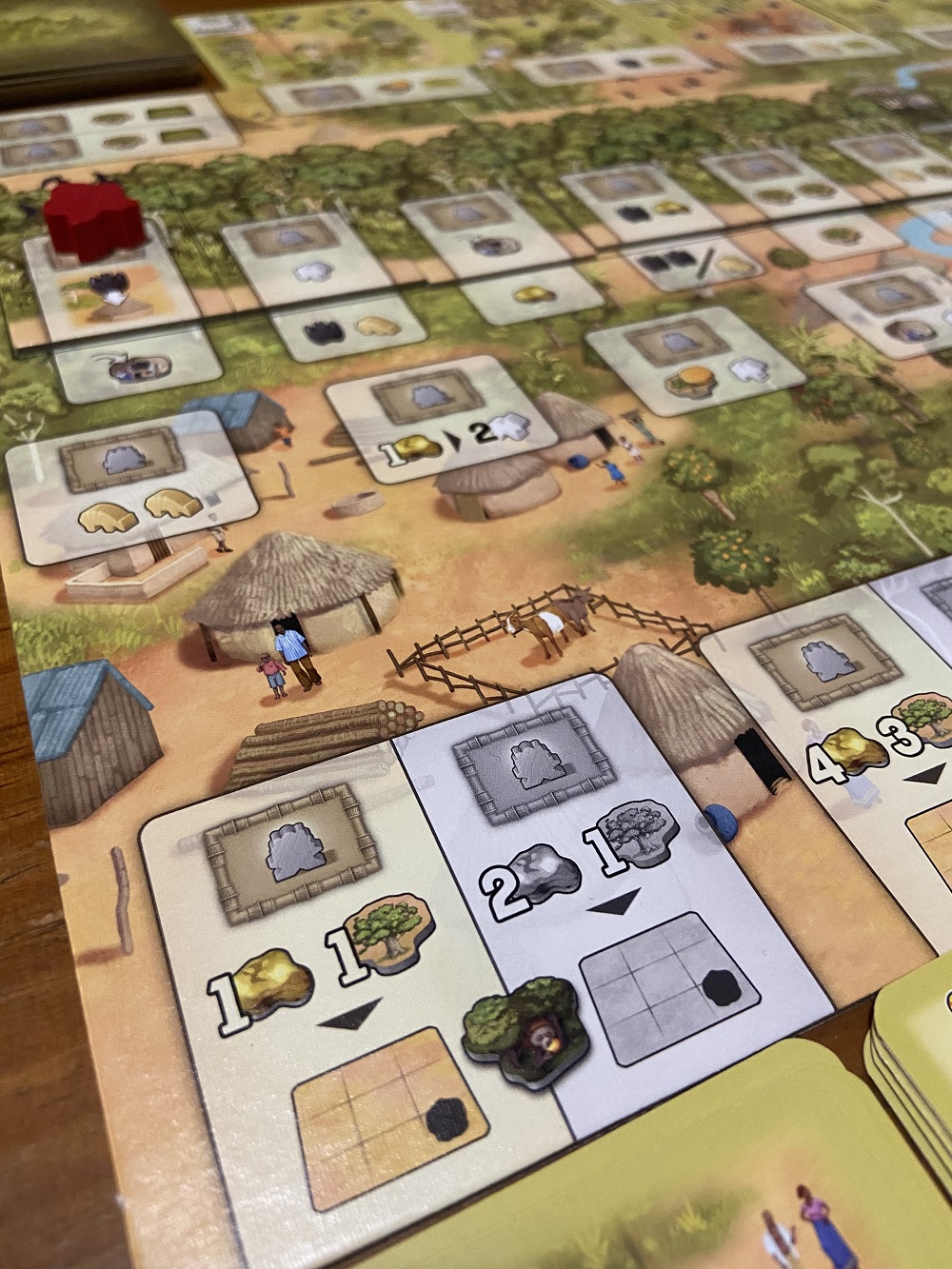
Set-up for Atiwa takes both time and space. Ensure you have the table space for the main board, the additional cards, and room for each player to have their personal play area too. I won’t go through the full details for set-up as they are well-provided in the instruction book that comes with the game. However, here’s a pic to see how it looks.
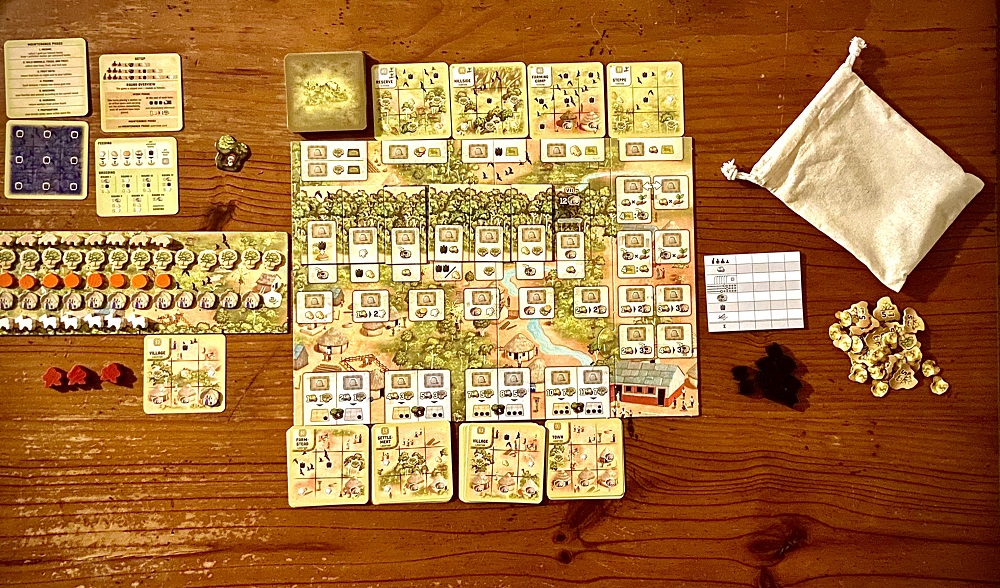
This is a general How-to-Play for Atiwa. The instruction manual has far greater detail, including explanations for each of the tokens, symbols, and cards used in the game.
- Gameplay takes seven (7) rounds. Each round includes a work phase and a maintenance phase. Each work phase has three (3) turns. Each maintenance phase has multiple tasks, most of which are automatic. Average gameplay is about 30 minutes per player, with extra time needed for first-time play.
- The goal is to collect points across six (6) different categories: gold, cards, supply board, trained families, fruit bats, and missing food (you actually want this last one to be empty).
- Choose a start player at random and give them the Start Player Marker. The other players receive ‘compensation’ relating to their player position (clockwise order)
- Each player takes one turn at a time for a mandatory worker action followed by an optional fruit bat action. Players are allowed a total of three (3) turns per player.
- For each mandatory worker action, start by placing one of your available workers on an unoccupied action space. You must immediately do the associated action. This can include drawing a terrain card, collecting depicted tokens, training a family, exchanging gold for tokens, carrying out nature tasks, collecting bonus tokens, collecting location cards, or paying for training actions.
- The first time you play (and often in the first round of the early games), choosing which Action Space to take can be overwhelming. Most Action Spaces allow you to collect various resource tokens, which are then placed on location and terrain cards. Place these cards in your Personal Play Area.
- To earn the points with the cards, you need to collect all of the resources indicated on the card. Sometimes, your workers must take specific Action Spaces to earn the resource tokens.
- At the end of each turn, you may have the option for a Fruit Bat Action. First, you will need at least 3x fruit bats, 1x fruit, 1x tree on your supply board, and room for at least one tree. To take the action, move three (3) fruit bats from your tableau to your night card. Then spend one fruit token and take one tree token. You can use bats collected from any worker action preceding this (even immediately preceding). The fruit bats on the night card will return in the maintenance phase, just like in real life.
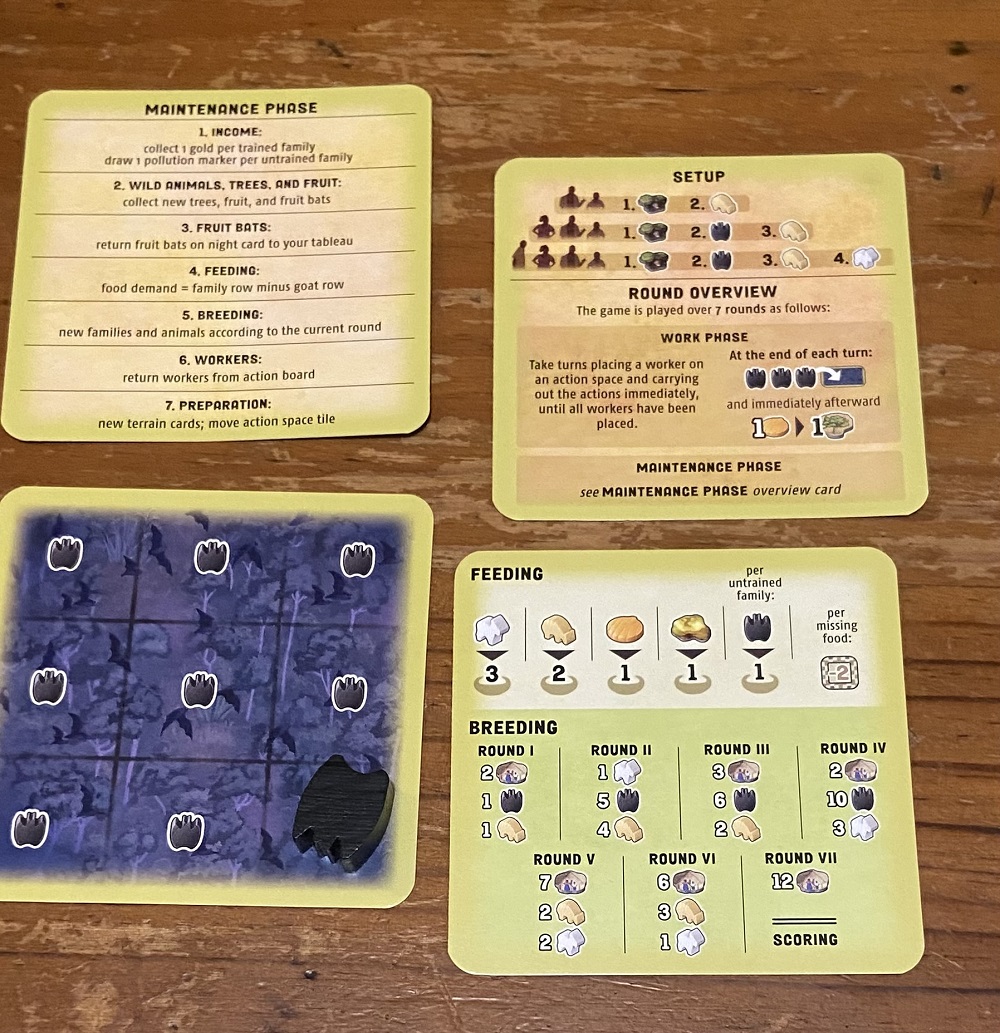
- Once everyone has had three (3) turns, the game moves to the Maintenance phase. Seven (7) steps must be carried out in the given order:
- Income: Each trained family in your tableau collects one (1) gold from the general supply. For each untrained family, draw one (1) pollution marker from the bag (eyes closed). Collect the gold from the general supply if it indicates a gold marker. Then place the pollution marker on your tableau.
- Wild animals, trees, and fruit: Collect new trees, fruit, and bats based on the number of wild animals, trees, and fruit you have in your tableau.
- Fruit Bats: Return the fruit bats from your night card to your tableau. Return as many as possible; any bats you do not have room for will return to the general supply.
- Feeding: Subtract the number in your goat row from the number in your family row to determine your food demand. If your food demand is greater than zero, you must spend tokens to feed. Eg. each goat you spend provides three (3) food tokens. If you do not have enough tokens to feed, you will lose 2 points for each ‘missing food’ token.
- Breeding: The current round ‘Action Space’ lists up to three (3) conditions in which you can collect new families or animals.
- Workers: Return your workers from the action board and place them beside your tableau for the next round.
- Preparation: Place any face-up terrain cards remaining beside the action board in a discard pile. Draw new terrain cards from the deck and place them face up to the right of the deck, one above each action space. If the draw deck runs out, shuffle the discard pile and form a new draw deck. Move the action space tile on the upcoming round space one space to the left.
- Once all the maintenance steps are taken, it’s time to move on to the next round.
- The game ends after step 5 of the Maintenance phase in Round 7. Then it’s time to count the points (check the instruction manual for point allocation). The best way to gain the most points is by balancing the requirements of all actions with the resources you can collect. Therefore, the player with the most points will show the greatest understanding of their environment and the ability to balance the village’s needs with the environment. In the case of a tie, the player who has fewer pollution markers wins!
Gameschool Benefits
As pointed out, this game is perfect for the geography syllabus. It covers locations and places through inspiration from the local king of Kibi and the village in Ghana. The Game addresses the region by discussing the balance of the farming economy with the village and managing the various needs of the families to survive. Atiwa also shows movement by training families and changing their conditions within the game. This also relates to human-environment interaction, looking at the impact trained families have on worker placement and the use of resources.
Using location and terrain cards will help players understand the need for spatial thinking within geography topics. It is essential to see how resources are spread across the different cards and how pollution will affect your resource collection. Finally, this game will also develop insight into cultural and social geography, exploring the dynamics of the village with the work required to prosper and compare this with other cultures around the world.
Will Atiwa Work With Your Family?
First up, I showed this game to a Geography teacher (Ms S), and they loved it! However, it did come with a caveat: this is different from the kind of game that is easy to play in the classroom. Ms S loved the genuine gameplay, with its complexity and the need to consider multiple levels of strategy.
“This is a game built on a real situation, so it gives students authenticity to their decision-making. They can see that these decisions directly affect the village, the people, and the environment.”
On the other hand, the game takes time for both set-up and gameplay. This changes the game from a classroom environment to an extra-curricular activity—something to play on a special day as a lead into a specific and related topic.
EG Sinister is our resident geography nerd (top of his class leading into Year 12 HSC and reads journal articles on topics like this for fun). Unfortunately, he doesn’t have much time right now (did I mention the HSC?!?), but he did talk through a few elements with me. Sinister agrees with Ms S about the ‘extra-curricular’ aspect, but he thinks that would also make this great for homeschooling or enhancing your existing geography studies.
One of the things he really likes about it is the point dependency on balancing village needs with environmental needs. A key element in geography, especially in high school, is discussing the relationship between humans and the environment. This is where the solo play really works well.
There are additional challenges provided in the Instruction Guide, aimed at solo play but I think you can work it into group play as well. Each of the additional challenges adds a focus that fits with the ongoing geography syllabus. For example, one challenge is to build three (3) towns and fill them with life. Another challenge requires no pollution. Atiwa’s additional challenges provide opportunities to dive into more specific geography concepts. Sometimes we can learn a particular concept in the classroom, but we need a practical application to understand it.
Final Thoughts
This is no ‘light-and-easy’ game, but that is probably its greatest strength. From a gameschooling point of view, Atiwa provides ample opportunities to teach and extend students within the core geography syllabus found across Australia. Due to the time to set up and play, Atiwa suits older ages; the box says 12 years and older, but I think you might be able to use this with 10-year-olds or Year 5 and higher.
For those who simply love tabletop games (and are not interested in gameschooling), this is one of the juicier games to add to your library. I love the solo-player mode, allowing me to enjoy by myself and test out new ideas or theories. I also enjoy family gameplay, learning from the different priorities and strategies in play. I prefer this with less competition than other games; there is a real risk of ‘analysis-paralysis’ as I overthink all possible actions to take, especially in the early rounds.
Atiwa is an investment game and worth every dollar. It currently retails for around AUD$80 at places like The Gamesmen.
OR…
Atiwa Giveaway
Thanks to Games Australia, I have a fresh copy of Atiwa to giveaway. For your chance to win your own copy of Atiwa, all you need to do is:
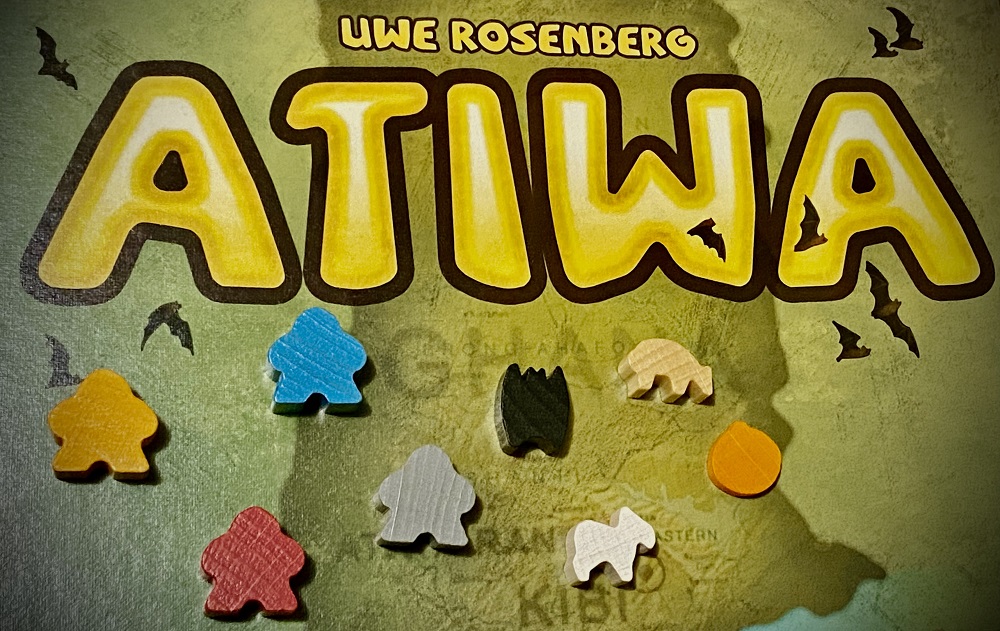
- Leave a comment below telling me which of the Atiwa meeples is your favourite (email is required for your comment so that I can contact you if you win)
- For a BONUS entry, head to my Instagram account here and again, leave a comment with your fave meeple
- For ANOTHER BONUS entry, follow Games Australia on Instagram here. I’ll cross-check their followers with my followers on both the Blog and the IG.
It’s too easy.
This giveaway is open to Australian and New Zealand residents only. Entries are open NOW and close Sunday, 11 June at 11:59 pm (AEST). The winner will be selected at random from the entries submitted as above. Only the winner will be notified via email or Instagram direct message and announced on social media once confirmed. The prize will be sent directly from Games Australia to your address subsequently provided. All conditions comply with the NSW Fair Trading for Promotion Gaming Activity.
EDIT: WE HAVE A WINNER!!
Congratulations to The Mitchells Home Education (IG: @rosewood_edu). You’re the lucky winner of a copy of ATIWA. Thanks to everyone who entered our giveaway and shared the review with friends/family. Stay tuned for more reviews coming up soon. I have a brand new 2P game for reconnecting with teenagers, and I’m revisiting a space-age fave from Denmark.
Categories: Curriculum of Evil Gameschooling

Evil Genius Mum
Evil Genius Mum
- Taking over the world, one blog post at a time
 Evil Genius Mum
Favourite meeple from Atiwa is the cute goat!
LikeLike
Those cute lil’ white goats are adorable. Definitely prefer goats in meeple form than real-life. 😉
LikeLike
Haha, oh gosh yes.
LikeLike
That little bat though 😍
Looks like an awesome gameschooling game!! Great review 😁
LikeLike
Thanks for the feedback! It seriously is such a good game for genuine geography studies. And bats. I mean, BATS!!!!!
LikeLike
I like the little bat meeple
LikeLike
If I didn’t like the game so much, I can think of so many artsy things to do with the bat meeples.
LikeLike
Love all the little animal meeples, but the bat is adorable!!
Thanks so much for the review sounds like a great game to add to our growing collection!
LikeLike
Thanks for the feedback – I really love promoting for gameschooling. I mean, sure – I love tabletop. But there is so much POWER in gameschooling!
LikeLike