An Aussie game with an Aussie theme and an international twist with the extra toppings.
Summertime, and I’m bringing out the recipe book from the tabletop game, Burger Up. Yes, you read that correctly. This tabletop game comes with amazing burger ideas. To be fair, this game has been in my collection since my first PAX Aus in 2017. Alas, it never made it to a GeekMom/GeekDad review, but it is absolutely overdue for some love here on Evil Genius Mum. Burger Up is one of those games that is brought out at social games to keep the spawnlings entertained while the BBQ does its thing. It’s also the absolute worst game to play while you are waiting for the BBQ to do its thing. So many burger suggestions, so many delicious options. And equally as many atrocities, as players try to make the best of the cards on offer while building ridiculous towers of ingredients that should never see the light of day. I mean, seriously: who puts brie on a beef patty mixed with tomato sauce and pickles?! Who raised you?!? I want to speak to the Chef, immediately!!

What is Burger Up?
Burger Up is a card-matching puzzle game where players build burgers to match specific design requirements to earn points. The game designer is Matt Parkes, and was published by Rule & Make. The game is aimed at 2-4 players but also includes a solo-play option. The average game takes 15-30 minutes, with an expansion pack that adds to the card options without adding too much to the gameplay time. The box says ages 10+, but once again, take it as a guide. The puzzle matching element can be managed from at least 8 years old, depending on the kid.
The idea is to build burgers and thus the esteem of your humble restaurants. As humble cooks, you first have to buy the ingredients from ‘the market’, then use the ingredients to match the pending orders. Each completed order wins payment points, including bonus points for the size or special conditions such as Colossal burgers with 10+ ingredients or ‘perfect’ ingredients with a bonus point. The card-matching element is part of the burger-building: you have to match your ingredients to those depicted on the card. And you can’t close off the burger until you satisfy an order. The winner has the most points at the end of the game, but in our family second prize goes to the best burger created–most of the time, decided with a very lengthy debate.
Burger Up is one of our rare games where the 2-4 players is actually the best set-up. Unfortunately, due to card availability, you cannot play more than four (4) players comfortably. If you can get your hands on two (2) sets of the game, I imagine a fun yet chaotic set-up! Let me know in the comments if you’ve ever done this and lived to tell the tale!
What’s in the Box?
Thank you to Rule & Make for giving us a box with decent storage!! Internal game storage isn’t exactly a reason to buy a game, but it definitely affects how often you play. No one in our family, and no child ever, wants to play a game that is a disaster to set up or pack away. Settlers of Catan is a prime example: a classic game the whole family loves, but we all cringe at the thought of packing it away, so we consider other games instead.
- 21x Top Bun Cards (customer orders)
- 72x Ingredient Cards
- 4x Player Aids
- 8x Bottom Bun Cards
- 4x Spatulas
- 32x $1 coin tokens
- 20x $5 coin tokens
- 8x $10 coin tokens
- 1x Burger Up rulebook
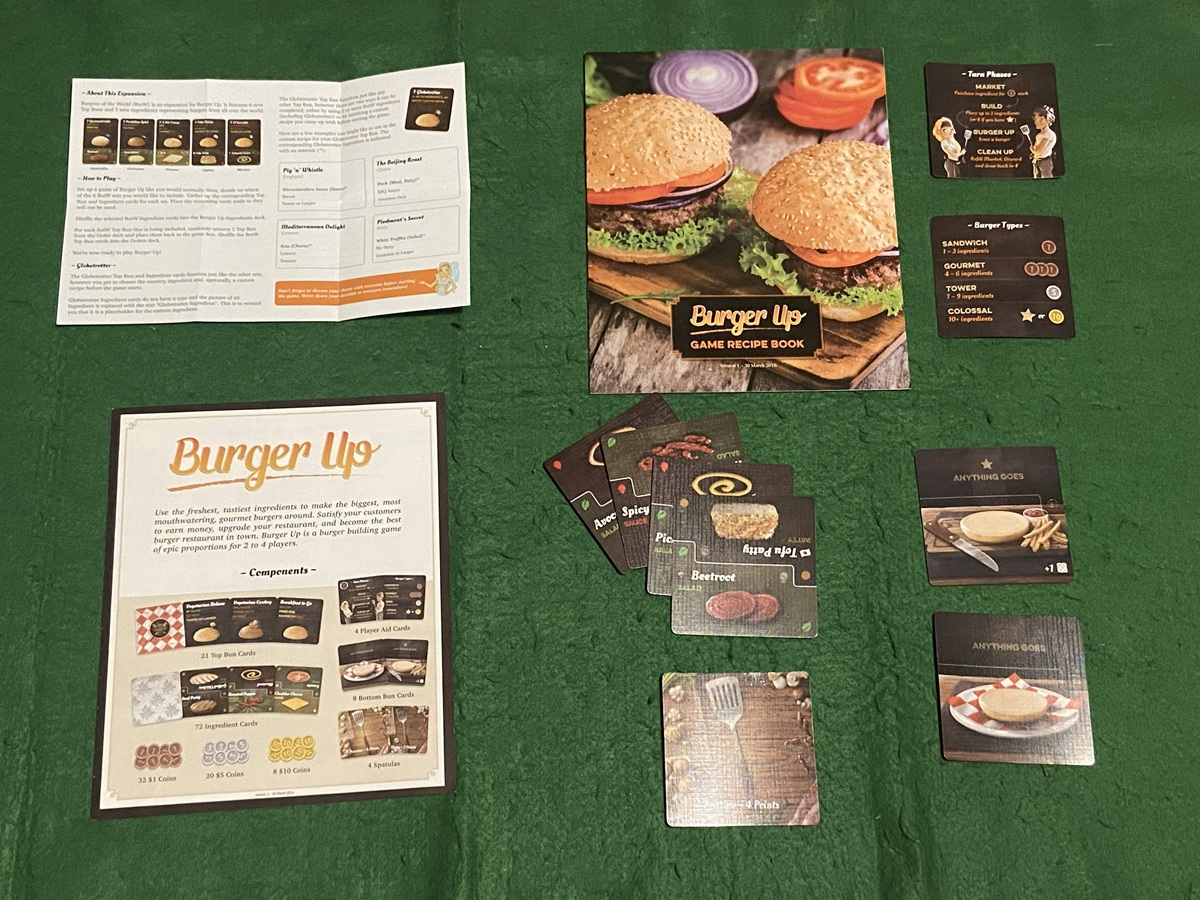
It’s worth getting your hands on the “Burgers of the World” Expansion Pack, which includes:
- Burger Up Game Recipe Book
- 6x new Top Bun Cards (customer orders)
- 5x new ingredients with international reference
All of the cards come with a glossy linen finish, very durable and holds the colour well for many years. Our copy of Burger Up is almost 10-years old and still looks relatively new. The coin tokens are made from thick cardboard and are the only components showing any wear. If you are looking for sleeves, the cards are all square-shaped, not traditional rectangular. A bit trickier to find, but not impossible.
How to Play Burger Up
Set-up for Burger Up is fairly straightforward, though you will need space for players to sit around, as the gameplay is based around a central ‘market place’.

- Shuffle all of the Top Bun cards to create the Order Deck. Place in the centre and deal three (3) cards face-up next to the deck to form the Pending Orders. Place a $1 coin token on each of these Top Buns.
- Shuffle all of the Ingredient cards to create the Ingredients Deck. Place it underneath the Order Deck, and deal three (3) cards face-up next to the Ingredients Deck (under the Pending Orders). This forms the Market area.
- Pile the remaining coin tokens at the end of the Pending Orders and Market place.
- Give each player two (2) bottom bun cards, standard side face-up. Each player also receives $2 in coin tokens and a Spatula card (pristine side face-up).
- Deal four (4) Ingredient cards face down to each player as a starting hand. Players can look at their own cards at any time.
- Play starts with who most recently ate a burger. If it’s a tie, EG Family rules go with whoever most recently MADE a burger. Give that player the Player Aid card with the First Player icon in the top corner. Everyone else gets a regular Player Aid card, and play continues clockwise.
- There are four (4) phases to each turn: Market, Build, Burger Up, and Cleanup
- Market: During their turn, players may spend $1 to purchase an Ingredient card from the market and place it in their hand. The coin token goes in the coin stash. Players can purchase more than one Ingredient card, but the Market is not refilled until the Cleanup phase.
- Build: During their turn, players may place up to three (3) ingredients from their hand onto either of the two (2) burgers in front of them.
- Each ingredient placed must match the requirements of the previous ingredient. The only exception is the ‘Middle Bun’ Ingredient card, which acts like a wildcard.
- The only way to undo an ingredient is to use the Spatula card; bonus points are awarded if you don’t use the Spatula.
- Burger Up: During their turn, players may score a single burger if it matches the requirements of a Pending Order. Even if you satisfy more than one order, you can only claim one (1) per turn. To claim that order, collect the Top Bun from the Pending Orders and place it on top of the burger you want to complete. You also collect any coin tokens with that order.
- Next, count the number of ingredients (excluding Bottom, Middle, and Top Buns) to determine the type of burger: Sandwich, Gourmet, Tower, or Colossal. Coin tokens are collected from the stash based on burger type.
- A bonus $1 is also collected for each “perfect ingredient” used.
- Place all ingredient cards used to create the burger in the discard pile face-up. The bottom bun is reused for the next burger.
- Draw a new Top Bun from the Order Deck and place it with the remaining Top Bun Pending Orders. Add $1 token to all three (3) face-up Top Bun cards. The longer a Top Bun card remains unclaimed, the more valuable it becomes.
- Clean up: During a player’s turn, they may discard any number of Ingredient cards from their hand, then draw from the Ingredients deck until they have four (4) cards in their hand. You cannot have more than four (4) Ingredient cards in your hand at the end of your turn. If you do, discard until you have four.
- If the Ingredients deck runs out, shuffle the discard pile and place it face down to form a new Ingredients deck.
- If you purchased from the Market during the Market phase, replace them by dealing Ingredient cards face-up until there are three (3) cards in the Market.
- The game ends when Pending Orders cannot be refilled. The round continues until it reaches the First Player, but without the First Player having another turn.
- The winner earns the most points, counting coin tokens, bonus points with the Spatula, and bonus points for the most Top Bun cards.
Matching Your Ingredients for the Perfect Puzzle Burger
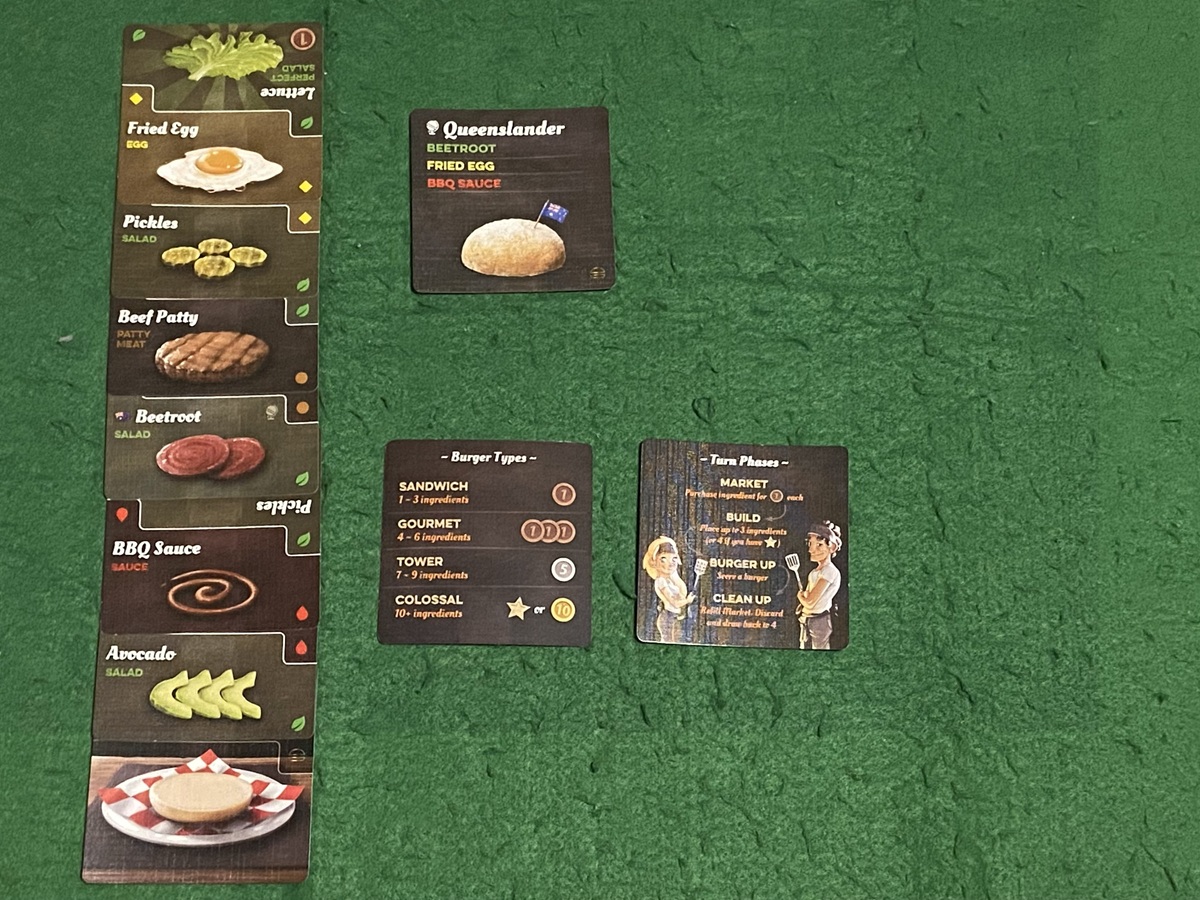
The puzzle element for Burger Up comes from the ingredient cards. Each card is double-ended; two (2) ingredients are shown on each side, depending on how you place it. Each ingredient belongs to one of five (5) types: Bun, Salad, Meat & Patty, Cheese & Egg, and Sauce. Each type also has a colour symbol which shows how to match the ingredient cards.

Say, for example, you have a BBQ Sauce ingredient card, and on the other end, it shows Pickles. The Pickles don’t count towards your burger ingredients; however, the Salad symbol shows that the next ingredient you place on this burger must also be a Salad type.
This is my favourite part of the game. There is something truly satisfying in constructing a gorgeous burger with the most perfect alignment of ingredients and all those pretty little symbols matching. It scratches just the right part of my brain. Of course, it is also equally frustrating when you are constantly waiting for that one Beetroot card to arrive in the Market. But that’s what makes this such a fantastic game.
Take the Kids to Culinary School: Burgers 101
So many Gameschooling options!! Seriously, this game is worth searching for because it really does offer so much to kids (while being loads of fun in general). On a basic level, Burger Up offers opportunities for simple puzzle-solving and visual matching. It also encourages basic maths calculations with managing the coin tokens.
However, if you are looking for something a bit more syllabus-based for Gameschooling, Burger Up suits many Food Technology discussions (based on the NSW Years 7-10 Syllabus). Students will recognise the importance of food selection, food trends, and food for special occasions as they navigate the requirements of customer orders and manage their budget to buy ingredients from the Market. This section also blends with Economics and business studies, as students must consider their ability to purchase and prioritise ingredients to meet customer needs and business performance. It’s the smallest of tastes, but Burger Up will have you rethinking just how easy you thought it would be to run a Burger Restaurant.
One more small gameschooling element to consider: Geography. If you can add the Burgers of the World Expansion pack, the set comes with extra food from around the world. For example, Brie for French-inspired burgers. It’s a small element, but to me it adds a whole additional level to the game. Students can learn where certain ingredients come from, which cultural influences to consider in a burger, and where to look for more inspiration. You could add an extra project to create a culturally specific burger, with a geographical study of local foods and customs. The World Expansion pack adds so much opportunity–and a whole new menu for my own cooking.
Where to Buy
Here’s the tricky part: Burger Up is an indie game and was published almost 10-years ago. It might be a little challenging to find. However, I found it on BIG W Marketplace!! Believe me, I was shocked too! This is only for the base set; you will have to search further afield for the expansion set. Big W currently has Burger Up selling here for AUD$53.95, close to the original RRP. Absolutely worth the price. Note: That is not an affiliated link. Just the best-selling place I found.
Score: 4.5 sides of fries (5 out of 5 with Aussie Chicken Salt with the Expansion Pack)
Evil Genius Mum received a review copy of Burger Up for this review. No payments or further incentives were received. All views are my own, with input from the EG Family and friends who played with us.
Categories: Curriculum of Evil Gameschooling

Evil Genius Mum
Evil Genius Mum
- Taking over the world, one blog post at a time
 Evil Genius Mum
Minion Musings: