Let’s be real: I had every intention of getting this out earlier, to give us all a chance to prepare something a little more ‘FUN’ for World Environment Day. But the truth is, time is not on our side—not for publishing articles, not for managing our daily lives (especially with spawnlings), and most importantly, not for the environment.
The focus this year is on restoration. Right now, global leaders (or at least their climate/environment counterparts) are meeting in the Kingdom of Saudi Arabia, discussing various ways to protect vulnerable ecosystems, revive those that have been severely damaged, and build our resilience against desertification, drought, and a bunch of other deteriorating factors. You can read more about it on the official website here. This whole decade is meant to be a collective united focus on ‘ecosystem restoration’. And yet, the one thing we can’t seem to restore is some authentic action in doing something about it. If anything, it feels like we spend a lot of time teaching our primary/elementary school kids all about the importance of balanced ecosystems, and then we ignore the problem until we’re grown-ups dealing with high insurance premiums for increased ‘severe weather risk’. It’s a serious situation, and it’s time we start taking it seriously.

Sorry. My Gen-X is showing. #notsorry
Now, despite the slightly serious tone of the previous paragraph, I’m here to share some ideas on how to reignite our passion for World Environment Day. Specifically, how to do it through gaming. And not just for a day, but throughout the year. ‘International days’ can be a great subject for gameschooling, and the suggestions I have here will benefit any syllabus. But the real task is how to use this same motivation with an older group of players. Are you up for it?
Challenge accepted. Hold my dice tray.
Tabletop Games for World Environment Day
Choose Your Own Ecosystem: Meadows, Marine, or Savanna?
The obvious (and honestly, the best) choice: Ecosystem from Genius Games. If ever you need a refresher on the importance of biodiversity in the restoration of ecosystems, this is the game to play. And it is so good at the core concept, you won’t even realise you are (re-)learning while you play.
Players build their own ecosystem in a grid using an open card-drafting mechanic. However, the point-scoring system rewards a bit more thought as to what you include in your ecosystem and how you plan out. For example, be careful about how close your eagle is to your river stream and those juicy-looking trout. The highest score wins and is usually the player with a greater diversity of cards in play.

We have both Ecosystem and Ecosystem: Coral Reefs in the EG Lair; Ecosystem: Savanna is on the way and I can’t wait to review it for you. For a full review and comparison between Ecosystem and Ecosystem: Coral Reefs, check out my article here.
Restore the Forest with Photosynthesis
Photosynthesis is one of those games that captures a scientific concept with such simplicity. It is a competitive turn-based game played across two phases and designed for 2-4 players. Action points are collected in the first phase (“photosynthesis”), which are then used in the second phase to trade for seeds, trees, and composting. The goal is to score points by taking your trees through a full life cycle, collecting when the largest tree eventually dies and is removed.
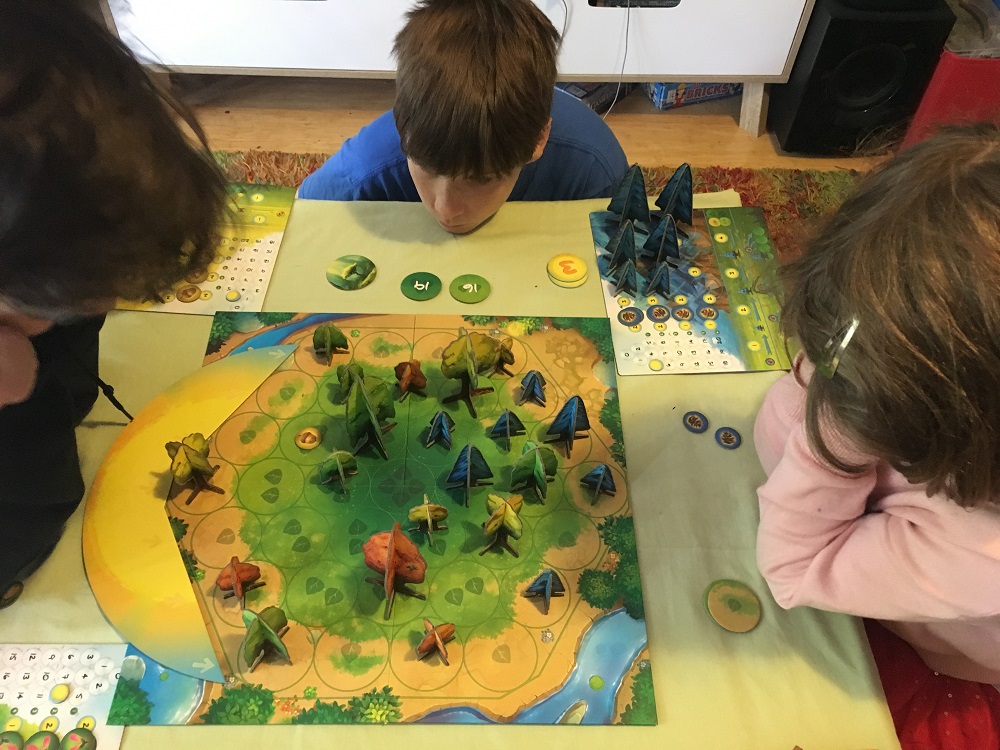
The game is gorgeous, in part thanks to the publishers Blue Orange and how they brought the visual cues to life. I especially love how the sun moves around the board, provoking more thought about the interaction between your trees and those around you. Restoration and reforestation are essential, but like Photosynthesis, it requires a bit more consideration than randomly scattering seeds around.
Respect the Desert Plains of Sonora
Natural deserts can be a good thing. But like any other biome, they needed to be respected and supported. Sonora, from Pandasaurus, is a great game for exploring multiple elements that support a healthy desert environment.

The game is a “Flick-and-Write” game designed for up to four (4) players. Each player flicks wooden discs across the board, divided into four (4) distinct areas: cliffs, canyons, creek beds, and mudcracks. Each of these areas has its own mini-game with some small features crossing over to the other areas. In one area, you use your disc points to take over cliffs in the area. In canyons, you are creating Tetris-style shapes to fill out the puzzle and collect cactus. For the third mini-game, you must follow the creek beds with various destinations, points, and bonuses. The final area has mud-cracks for you to fill and create mini zones for points. All of them are true to the desert theme with little details to round out the experience. You can play this game in a quick-and-easy manner or you can take some time to strategise across multiple areas.
To be honest, I would have loved to have seen a little more co-dependency across the four areas and a bit more detail about how they all link together. However, the game does well to highlight the fallacy of division and the importance of monitoring all features.
Video Games for World Environment Day
Explore Environmental Biomes with Minecraft
Probably the most obvious choice for video games to play on World Environment Day, purely because of how they have incorporated different biomes across the landscape. Minecraft is possibly one of the best sandbox video games available, providing an opportunity for players to create almost anything they want in any environment. Each time you load a new game in Minecraft, it randomly generates a world filled with biomes and resources for you to farm, use, and manage. Biomes are regions within the Minecraft world with distinct geographical features including plants, animals, temperatures, weather patterns, and resources. In Java Edition, there are 64 different biome types (Bedrock Edition has 86), including mushroom fields, warm oceans, and ‘windswept savanna’.

The nerd in me could easily sit and watch the weather change across these biomes. For example, the weather indicator might say rain but because you’re in a Savanna, you may not actually see the rain falling. I have also noticed it takes longer for trees to grow back in this environment; something to keep in mind for the real world too. Overall, Minecraft is a great video game, for both solo play and multiplayer, to explore the impact we have on the environment and potentially how to restore it.
What Happened After: The Talos Principle II
But what happens if we do nothing? Well, we all die and the robots try to re-live our hey-days with a little more consideration than we did. Dark? Oh yeah. But rather pragmatic. And something that is seriously considered in The Talos Principle II. However, to be fair, the game itself is not as dark and cynical as me. Thankfully.

TP2 is the long-awaited sequel to The Talos Principle (TP1), arguably one of the best puzzle games ever made. It’s up there with Portal and Myst, both of which are the benchmark for the genre. TP2 is all of the puzzle-solving of TP1 plus the extra narrative and philosophy of what happened after the humans messed up. While there is a lot of discussion about Artificial Intelligence and our sense of identity, there is also a strong theme of social and collective responsibility. What qualifies as humanity, what is our role within the environment, and where does our sense of responsibility lie? There is so much in the story that considers what humans left of their world, and how any of that could have inspired an AI race to think it was worth replicating in a new world. If it was really that good, why didn’t we fight harder to protect it?
For more details, you can check out my review of TP2 here.
World Environment Day
An internationally recognised day such as this should not have its message limited to a mere 24-hour cycle. This should be the start of the discussion. Or even ideally, the restart of a conversation we have been having for years but have now found a little more motivation to move forward. Yes, I totally agree: There are already so many days to celebrate. World Oceans Day, Earth Day, Elephants, Dolphins, Penguins. It can be overwhelming to think we need to act every day, to the point of numbing us against the message. However, when we include games like these in our lives, we have the opportunity to reignite the discussion. We have the chance to introduce someone new to the concept. Either way, I like to think of games as the ultimate way to keep us focused on solutions rather than ignoring the problems.
Let me know if you have any suggestions to add to this list. In the meantime, enjoy your game time and on your next turn, start up the conversation.

Categories: Curriculum of Evil Gameschooling video games

Evil Genius Mum
Evil Genius Mum
- Taking over the world, one blog post at a time
 Evil Genius Mum
Minion Musings: