I said it when I reviewed the Kickstarter campaign, and I’ll say it again now the game has been released: Floating Floors has the cutest ninja meeples I have ever seen. Possibly one of my top 3 meeples ever. And y’all know I love a game with tactile elements. Something you can touch, feel, and blame on your uncoordinated chonky fingers when everything goes pear-shaped. Floating Floors is precisely that and more. It was first previewed with PAX Aust 2021, launched via Kickstarter in 2022, and is now available to buy in its final master form. I had previously reviewed the Kickstarter version for GeekMom (you can read it here). Now it’s time to revisit the final version! So stretch your tabletop muscles and limber up. We’re balancing all of the features in Floating Floors from Guf Studios.

What is Floating Floors?
Floating Floors is a tabletop game designed for 2-4 players, but it best suits two players. Each game takes around 30 minutes to play, and while the age recommendation is 14+, 10-year-old Zaltu has been able to play the game easily since around 8 years old. I can see this game being a massive hit for gameschooling around the ages of 10-years and up.
The game is a strategic balancing duel between two ninjas as they navigate across the boards. Around the perimeter of the game are four (4) Bansen seals. The goal is to be the first ninja to navigate the boards and collect all four of your Bansen seals. However, it’s not a simple stroll through the house.
| History Lesson 101: Nightingale Floors The key concept of Floating Floors is based on the famous Nightingale floors (or uguisubari 鴬張り) used as a kind of security system in some Japanese temples and palaces. The most well-known example features in Nijō Castle, built during the Tokugawa Period in Kyoto, Japan. The floors are known for making a chirping sound when walked on, announcing anyone attempting to sneak through the halls and rooms. While there is still some debate about whether the result was intentional, it remains pretty effective as an old-school security system. I mean, who doesn’t have a squeaky door or floorboard in their home? |
In Floating Floors, your ninja must navigate across the boards without triggering the security system. However, instead of a chirping sound, you must face precariously balanced floors that will topple you into the waters below.
What’s in the Box?

- 12x Terrain/Lake Cards (double-sided)
- 12x Floating Floorboards (double-sided)
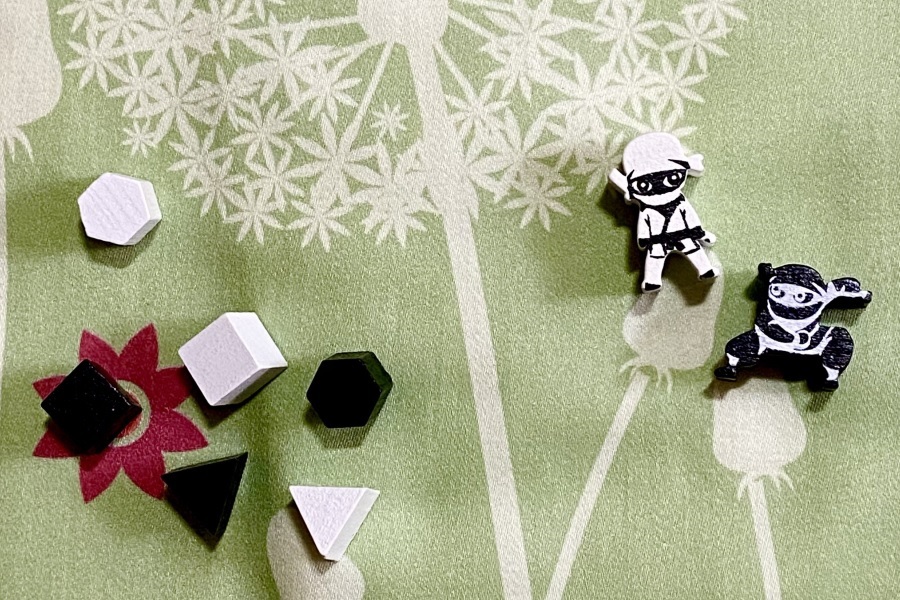
- 60x Jutsu Tokens–featuring three different shapes (triangle, square, hexagon) in both black and white
- 3x Jutsu Dice–featuring three different shapes (triangle, square, hexagon) in either black or white
- 4x Ninja meeples (2x Black and 2x White)
- 16x Bansen seals (double-sided)
- 4x Chakra tokens
The ninja meeples and the Jutsu tokens are made with painted wood, including some very cute facial details on the ninja. The Jutsu dice are made from solid plastic, and the rest of the components are made with sturdy cardboard. I love how durable all of the pieces are, considering how tactile this game is. Every piece is going to be handled–a lot! As a gamer, you want to be reassured that the game will survive the play. I can definitely vouch for its survival in the EG Lair.
The one area with room for improvement is internal storage. The box design is neat and compact, however, it heavily relies on various plastic resealable bags to store the various pieces. This is understandable, considering how many Jutsu tokens there are and how they would float around the box (pun intended). Nevertheless, the EG Family is working hard to remove/reduce excessive plastic from the EG Lair. While this doesn’t mark against Floating Floors, it is an opportunity for all game designers to consider from now and into our future.
How to Play Floating Floors
The winner is the first ninja to successfully move across the floating floors to collect each of their Bansen Seals. Players take turns collecting Jutsu tokens by rolling the dice and using the tokens to balance the floating floors above the terrain cards.
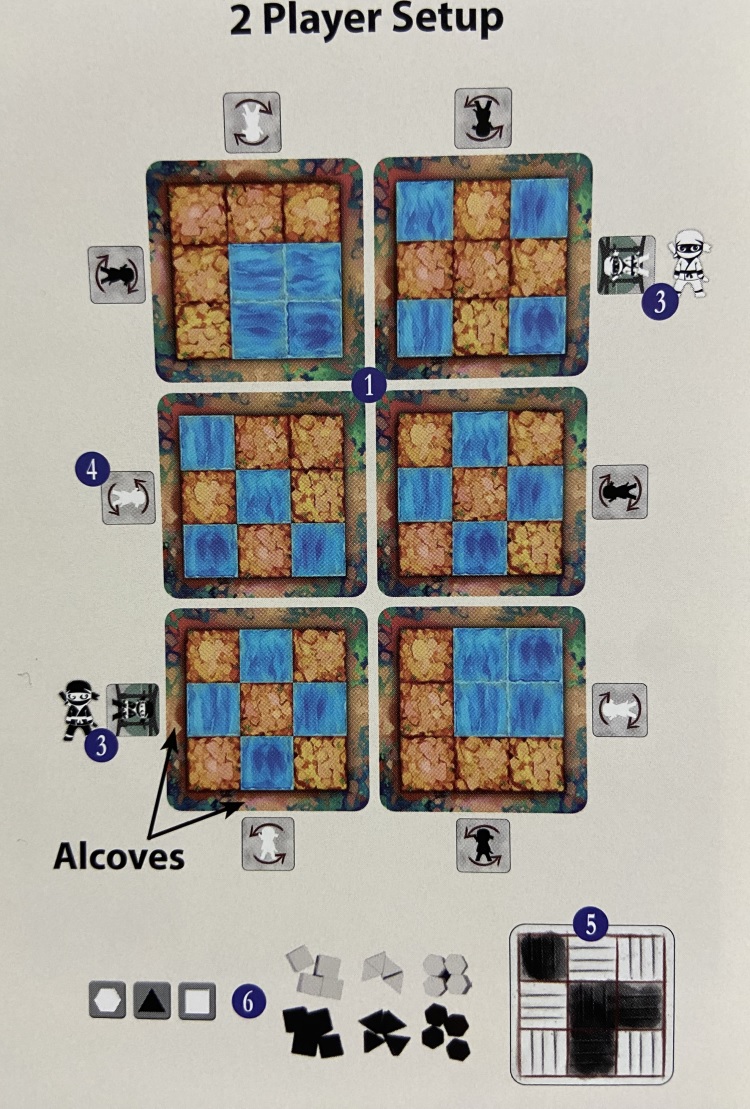
The game starts with a shuffled deck of Terrain Cards. For two players, a map is randomly created with six cards placed in a 2×3 grid. For three or four players, the map is nine cards in a 3×3 grid. Each player takes a Ninja, a ‘Chakra’ showing their ninja, the Bansen seals for their ninja, and one of each Jutsu of your colour. Your ninja and matching Chakra start in an alcove on the map’s perimeter. Each of the Bansen Seals is also placed randomly in nooks around the outside. The remaining Jutsu go into a collective pool next to the shuffled deck of Floorboards.
Players then take turns completing two phases in each turn. First, a player can acquire Jutsu with a roll of the dice. Players can take Jutsu from the collective pool or terrain cards and floorboards (as long as a ninja is not standing on top of that piece). Even from the very beginning, this can be a significant strategic move and has destroyed me in many games.

Phase 2 is about navigating the floorboards. The concept is relatively easy in theory: ninjas can only move on squares of their colour, and you must be careful not to overbalance your Floorboards. If the card tilts or falls, touching the terrain card beneath it, you must restart, and your opponent is allowed to rearrange all of the pieces. It’s a pretty hefty penalty and one that can up-end a good strategy in play.
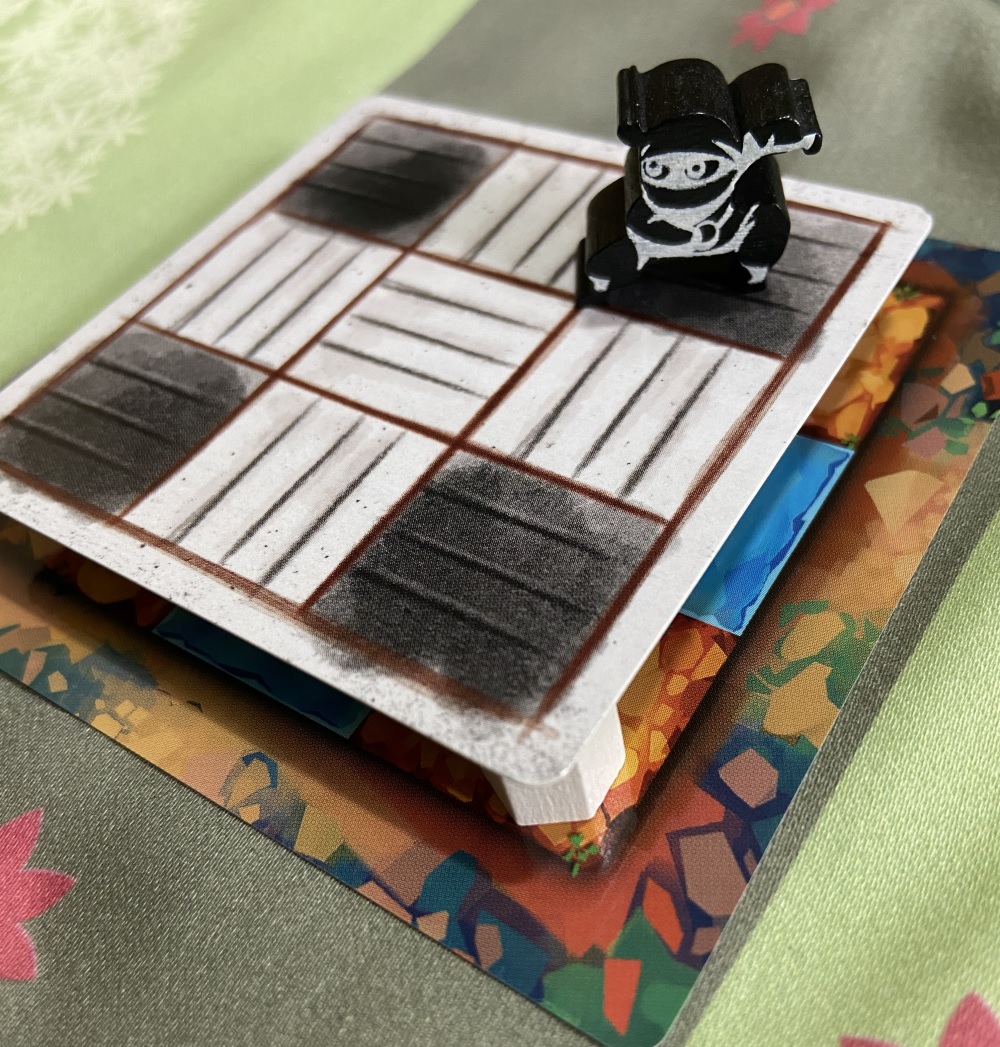
Each terrain card has land or water featured. Players can place Jutsu tokens (with different shapes) on the land squares of the terrain card. You can use any colour or shape token and place as many as you like. Then you can place a randomly selected Floorboard from the deck; each side of the Floorboard is slightly more favorable to one colour over the other. But don’t stress–you can also place Jutsu on top of the Floorboards to modify the colour to yours. This will also shift the balance, so to speak. So choose wisely.
Once you navigate across the floor to your Bansen seals, you must pick up the Floorboard and rotate it 90-degrees to claim the seal. Claim all of your seals, and you win! However, your turn ends when you cannot move or you cause a floorboard to topple at any point during your turn.
How to Use Floating Floors in Gameschooling
I am always on the lookout for gameschooling opportunities. We all know how much fun tabletop is on its own, but tabletop games can be valuable tools to help our kids understand various topics. Some games are apparent in their benefits, while others are better for creating a micro-environment for learning a specific subject. Floating Floors is right up there as one of the best games to incorporate math and science with gameschooling. It’s a fantastic and fun game covering a few different topics across multiple disciplines.
- History: The core concept of this game is based on the history of Nightingale Floors used in some ancient Japanese castles. There is plenty to learn about the history and politics of the Tokugawa era, especially with the role of ninjas between wealthy families.
- Physics and Engineering: The Jutsu tokens come in three different shapes–square, triangle, and hexagonal. Kids can learn a lot about balance and structure as they strategically place their Jutsu and floorboards across the terrain cards.
- Electronics and Technology: Bring history and Engineering together to look at security technology development. It is an excellent opportunity to learn how security systems have evolved from noisy floorboards to motion sensors and beyond.
What Do We Love About Floating Floors?
The gameplay is fun and fast, with plenty of strategy in both attack and defence. We love the story concept of the game, using ninjas to navigate the self-made labyrinth of floorboards. Best of all, we love the tactile experience of playing the game. The joy of physically balancing our meeples as they often face the perils of poorly placed Jutsu tokens.
Speaking of tokens, quick shout out for the ninja meeples. They are adorable and perfectly made to fit the game—a definite stroke of genius there.
Floating Floors is available to buy on the official Guf Studios website here.
Score: 4 out of 5 sneaky ninjas

Thanks to Guf Studios for the review copy of ‘Floating Floors’. No money changed hands for this review. All views and opinions are my own.
Categories: Curriculum of Evil Gameschooling

Evil Genius Mum
Evil Genius Mum
- Taking over the world, one blog post at a time
 Evil Genius Mum
Minion Musings: