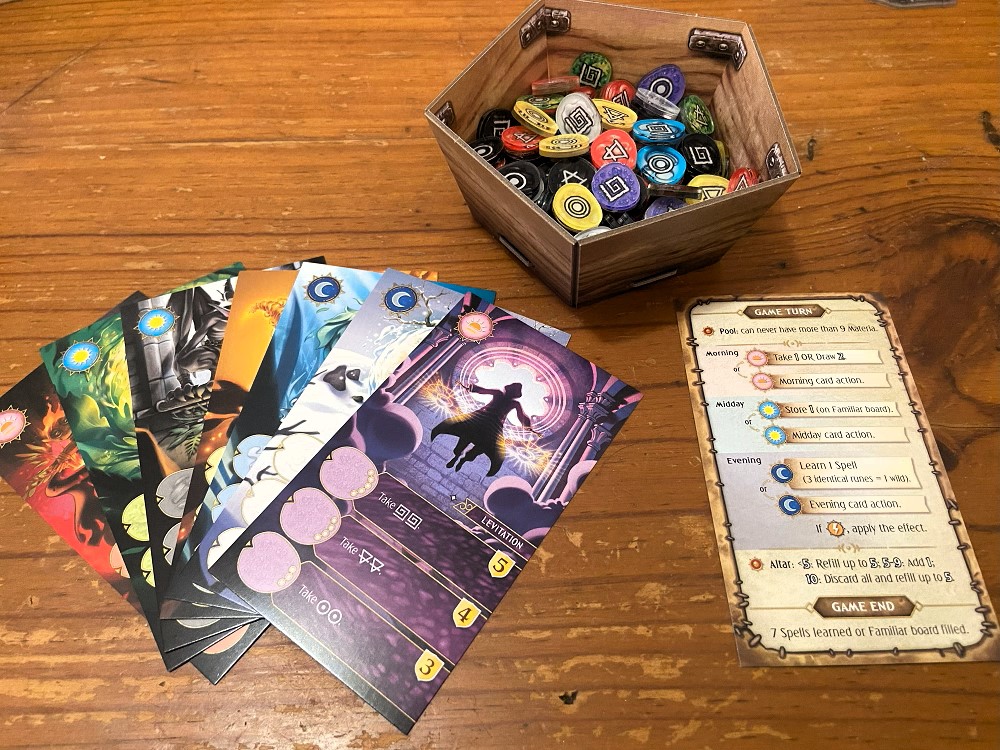
When shall we three meet again? For it is time to enchant the masses and conjure some tabletop magic with Spellbook, the new game from Space Cowboys. This fun game is inspired by the set-collection mechanic behind ‘rummy-style games’, but it is brought to life by its fantastical and magical nature. Each player is a wizard, focused on being the first to complete the spellbook in whatever way works for them. As you play this game day and night (figuratively speaking), you will need to balance your resources and strategise over which spells to learn first. Will you choose the quality of spells over quantity? Or race to complete your spellbook and force your fellow wizards to make hasty mistakes. Take on the strategic gameplay of Spellbook and learn how to budget your resources for the greater outcome.
What is Spellbook?
Spellbook is a fantasy game with a set-collection mechanic relying on your hand management with just a fairy dust sprinkle of luck. Players take the role of wizards, accompanied by their loyal familiars, as they join in the Annual Grand Rite. The goal is to fill your Spellbook with new spells, powered by the magic symbols received from the Vortex. Each of these symbols is known as Materia, holding the power needed for different spells. Wizards can use the Materia to learn new spells or to store the power within their Familiars. The contest ends when any wizard completes their Spellbook, or their Familiar is filled with power. The winner is the wizard with the most points.
What’s in the Box?
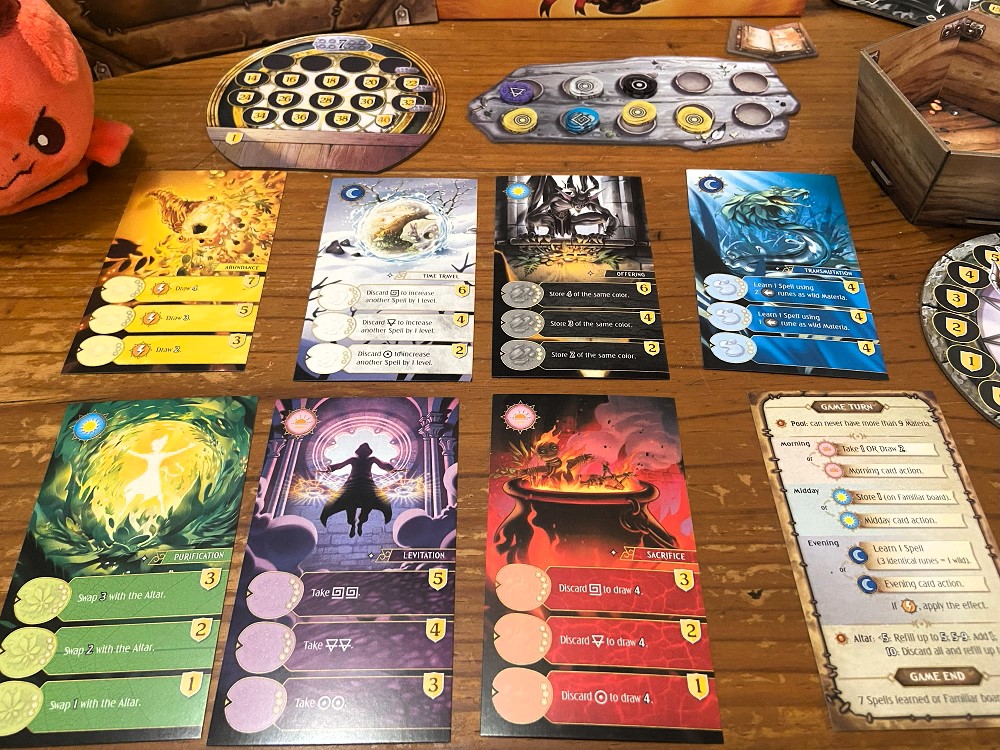
- 1x Vortex Pouch
- 105x Materia tokens in 7 different colours
- 1x Altar tile
- 1x First Player Token (in the shape of an open book)
- 4x Familiar boards (a cat, a dragon, a wood golem, and a gargoyle)
- 4x Spell decks (1 per player) with 21 cards each. Each deck has 3 sets of 7 cards, each with a small picture of the corresponding familiar at the top of the card on the back
- 4x Player Aid cards
- 1x Discard box (requires a little assembly)
- 1x Rulebook
All of the components of Spellbook are utterly beautiful, and you should really take a moment or two to stop and appreciate each of them. Otherwise, you’ll constantly be distracted during the game with the “Ooooh, that’s pretty” and “Ahhh, check this out”. Trust me: I’m doing you a favour with this advice. The artwork comes from Cyrille Bertin, the artistic genius behind When I Dream and its very dreamy imagery.
For example, the Materia. These tokens are essentially the currency of the game. There are 105 tokens in seven (7) different colours with one of three (3) different symbols on them. Each of the colours corresponds with the different elemental spells, while the symbols offer variations to each spell. The tokens are made of a thick perspex (hard plastic), very durable and protected. They are going to bounce around in the pouch, so I’m really glad to see the developers/publishers went the extra step with the protection.

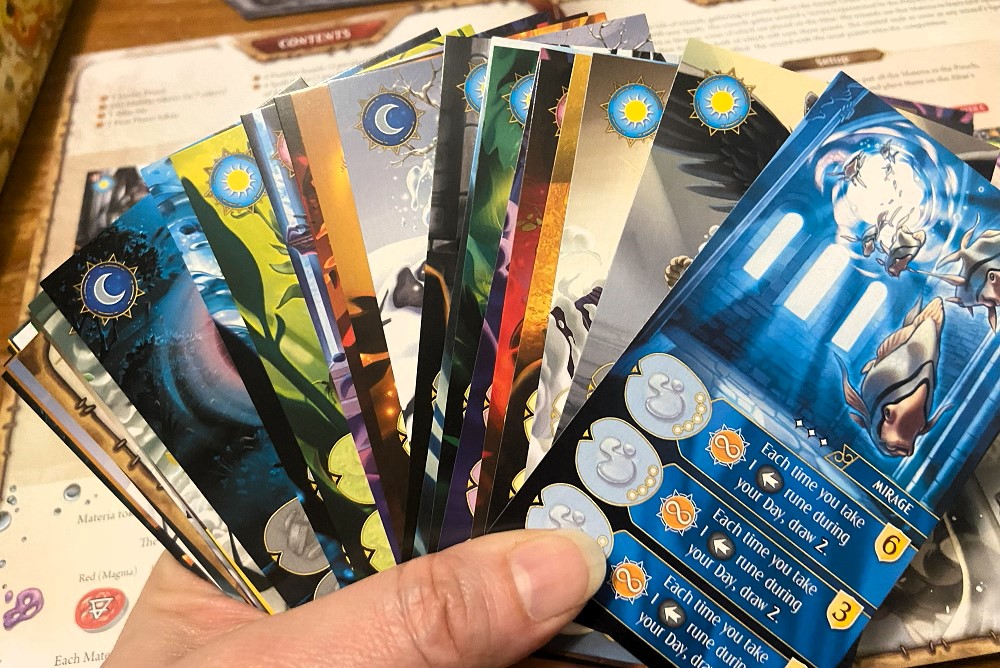
The cards, however, could really do with some sleeves. Don’t get me wrong, the cardboard is good quality cardboard with a gloss sheen. However, the illustrations are gorgeous. I’m talking high-level detail, reminiscent of the early days with Magic: the Gathering cards. I want to protect these cards, but the size and shape make it a little tricky to find the right sleeves. Spellbook cards are longer and thinner than other playable cards, like Pokemon or Yugi-Oh. They are more akin to Tarot cards (possibly intentional), so look for sleeves to fit 70 mm x 120 mm like these sold through Gameology.

Each of the larger cardboard pieces is made with thick durable cardboard with a linen finish. Again, the artwork is stunning, and I love the design of the Discard box, which is a five-sided wooden barrel. This piece requires some assembly before your first play.
My only disappointment is the storage, especially for the Discard box. While the inside of the game box has a separate section for the cards, it is not self-contained, and the cards have a tendency to slide a bit. Another reason to invest in some card sleeves. There is only one other compartment for game storage: a large square shape that does not work with the five-sided Discard Box. There is a way to store all the components neatly inside the game box, but it is a bit fiddly and does not reassure me that all of the beautiful artwork will be protected. This is a huge shame because it really is gorgeous to look at, and I don’t want to lose that over time. I would be prepared to pay a little more for this game if it provided a little more storage consideration.
How to Play Spellbook
There are two ways to play Spellbook. You can play with 2-4 players in a competitive manner, which directly affects how you manage your Materia. Or you can play solo, changing your strategy to focus on your spells, working against your ‘personal best’ each time. I’m going to focus on the multiplayer here.
You can also play Spellbook with varying levels of difficulty, giving you room to grow within the game. For your first time, start with the Level 1 Spell cards in your deck, marked by a single star on the face of the card.
- Set-Up: Place the Altar tile and the Vortex pouch in the centre of the play area with all of the Materia in the pouch. Randomly draw five (5) Materia and place them on the Altar’s empty spaces. Place the Discard box nearby
- Each player takes their deck and Player Aid card, and lays the cards in front of them in a 4×2 grid. Place your Familiar next to your spell cards.
- Each player draws two (2) Materia from the pouch to form your initial pool of resources.
- Gameplay involves three (3) phases: Morning, Midday, and Evening. Certain actions are available during each phase, with some spells offering the option of alternatives depending on the time of day. Players are limited to a single action during each phase but are not required to complete an action if they prefer not to.
- Morning: Players may choose to take one (1) Materia from the Altar or draw two (2) random Materia from the pouch. Either will be added to their pool.
- Midday: Players may store one (1) Materia with their familiar.
- Evening: Players may choose to learn one (1) spell, using the required Materia from their pool to do so. The Materia must match the colour of the spell to learn. One (1) Materia is placed on the Spell card to indicate which spell and which level has been learned. The remaining Materia are placed in the Discard box.
- During the Evening, players may use three (3) Materia of any colour to count as one (1) wild Materia. They must use at least one (1) colour-matched Materia but all of the others can be wild if they have enough.
- Some spells have instant effects once learned, marked with a lightning bolt symbol. This applied immediately during the Player’s turn. Other spells may have permanent effects, marked with an infinity symbol. These conditions continue for the rest of the game whenever the conditions are met during your day/turn.
- At the end of the evening, the player supplies the Altar to a minimum of five (5). If there are 5-9 Materia on the Altar, the player draws one (1) Materia from the Pouch and places it on an unoccupied space on the Altar. If there are 10 or more already there, the player discards all the Matera and draws a fresh five (5). If the pouch is depleted, the player must restock from the Discard box, and the cycle continues. It then becomes the next Player’s turn.
- The game ends when any player either learns their 7th and final spell or fills the last available space on their Familiar board. All players have the chance to complete the final round. Points for each spell are indicated on the card, as well as the points marked on the Familiar board. The Player with the highest number of points wins!

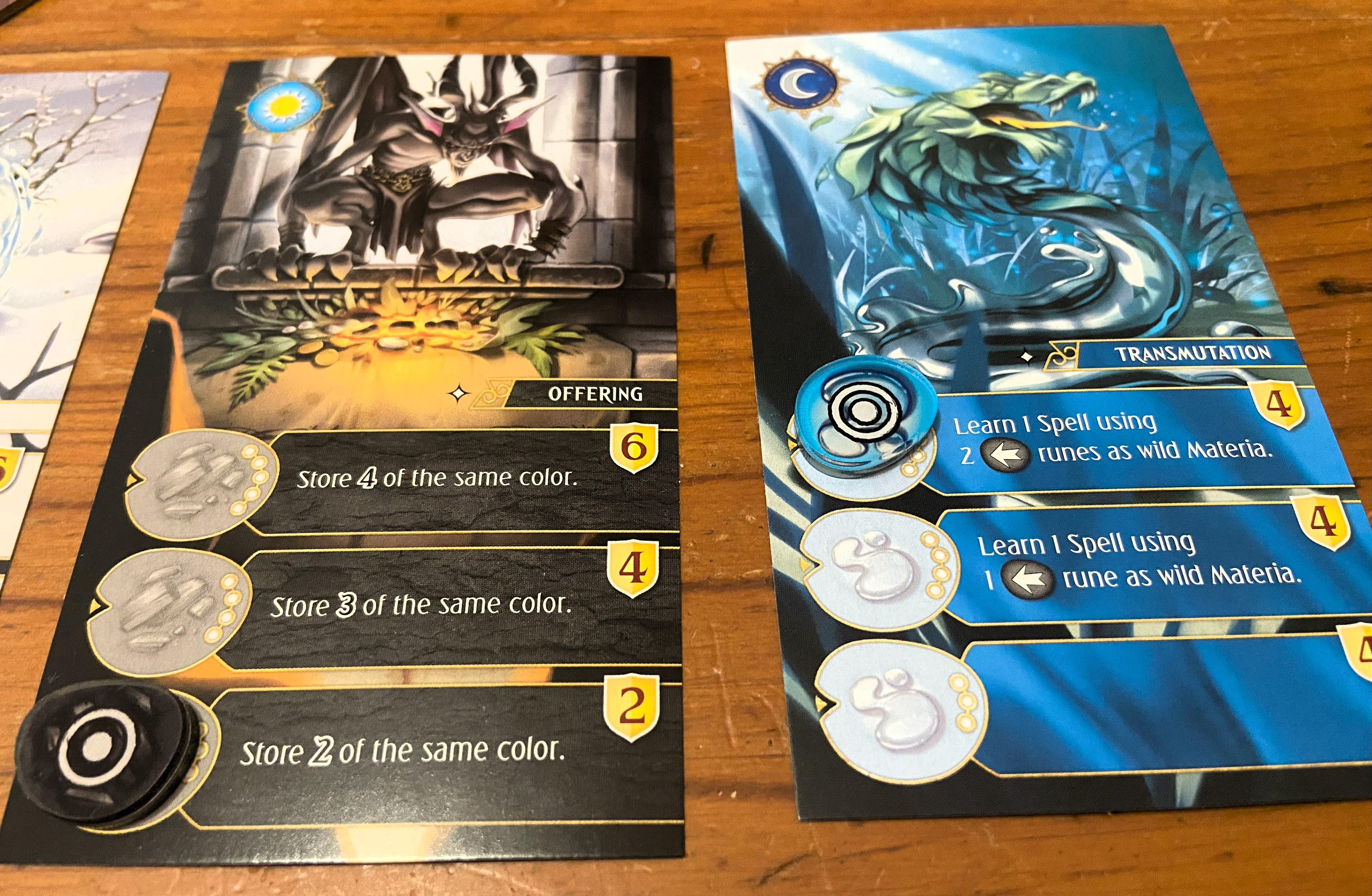
Kudos to the Developers for highlighting the Frequently Forgotten Rules on the back of the Instruction Manual. It was spot-on and very helpful for keeping us on track. The Player Aid cards are also very helpful, guiding us through our first game. It’s also important to check out the details of each of your spell cards. Some spells allow you the opportunity to upgrade your spells at a later date, which is REALLY useful for both using the spells during your day/turn AND calculating points at the end.
Learn From Your Spellcraft
There is plenty to learn from simply playing the game. The spell cards provide great detail in how the spells work, which encourages and develops reading skills. There is also some basic calculation with counting your resources and applying them to spell cards.
From a learning/gameschooling perspective, I really like how Spellbook develops a sense of budgeting. This is a resource-building game with a set-collection mechanic. However, the resource-building element is definitely underplayed. Kids can learn how to balance their resources to learn the right spells, upgrading at the right times and banking the right amounts. In some ways, it reminds me a little of the mechanic in Ticket to Ride. You may not always know which Materia you draw from the pouch, but it is still your responsibility to plan out how to use them best.
Personally, I really enjoyed playing Spellbook. The game feels much stronger when playing with others rather than playing solo. Multiple players push the strategy more as you each compete for the Materia you need. The competition also helps keep the game moving through the dreaded hump when the Materia just won’t help out! Solo-play taught me more about the strategy of which spells to learn first, but it did not transfer in the same manner to multi-player. All of my solo practice meant nothing against the spawnlings!
Where to Buy Spellbook
Spellbook retails for around AUD$69.95, though I have seen it on sale for AUD$54.95 at the GamesMen, which seems like an absolute steal for this quality of game! If you are heading to PAX Australia, swing by the VR Distribution/Games Australia stall and check out their availability–It’s on my list of 10 Steps to PAX Aus 2023, in Melbourne 6-8 October 2023. You could also have the opportunity to chat with the game’s developer, Phil Walker-Harding. Phil is also the brains behind Sushi Go! and Busy Beaks (see my review here).
Make sure you pick up the sleeves as well, for around AUD$4.95 for a pack of 100. Well worth the investment. If your local game store doesn’t have Spellbook in stock, tell them to contact VR Distribution now!
Score: 3.5 whispered dark spells out of 5. I would have knocked it up to 4 if there was a little more thought put into the storage compartments.

Categories: Curriculum of Evil Gameschooling

Evil Genius Mum
Evil Genius Mum
- Taking over the world, one blog post at a time
 Evil Genius Mum
Minion Musings: