Rarely do you find a game that embraces its simplicity with as much love and care as Aethermon. I have reviewed a few games of late that are super complex; in some cases, far more than they needed to be. Aethermon has walked off in the other direction completely. The developers have created a game that is simple to play and even more enjoyable to share with others. Aethermon is a card game, and yes–it does tread the fine line of imitation to the point of sincere flattery. It also stands out on its own with both narrative and gameplay. Enough to bring out the crowdfunding? Absolutely!
Aethermon: What is It?
The spawnlings were the first to spot Aethermon: Tower of Darkness at PAX Aus 2022, one of my top ten recommended with GeekMom here. Currently in development, A:ToD starts off with a bit of a Pokémon feel: capturing monsters and using them to battle other monsters. However, where Pokémon is a simple battle mechanic, A:ToD is built on a strong narrative and adventure-tower mechanic. As a co-op game, you can play with 2-5 players with about an hour of gameplay. Each player chooses an elemental monster to battle with them as they ascend the Tower of Darkness and prevent the ancient evil from being unleashed. EG Family had a small taste of the battle style and the storytelling, showing some of the artwork and development. A:ToD featured in the PAX Aus 2022 Indie Showcase, and I wouldn’t be surprised if they are back for PAX Aus 2023.
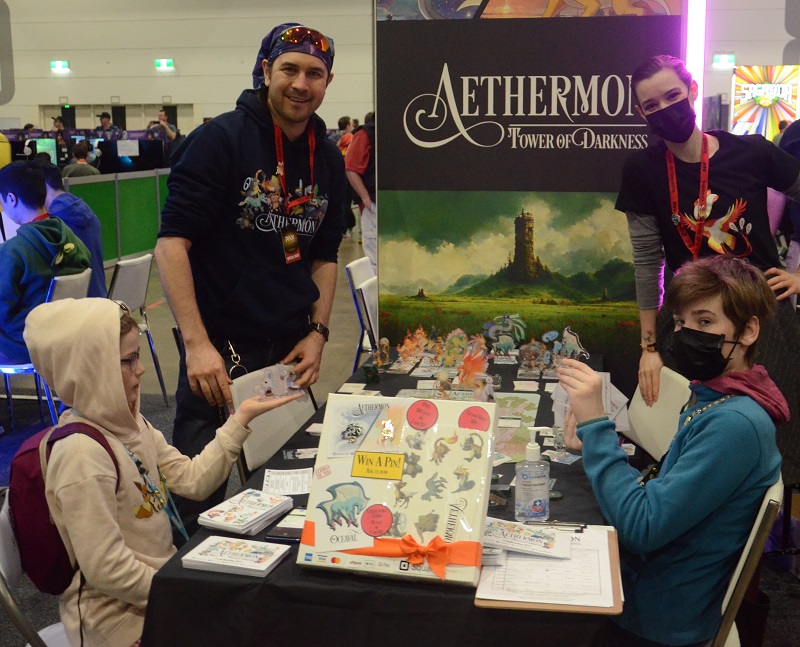
While we wait for A: ToD, the developers have created a mini-game for a bit of world-building introduction. It’s a smart move, as players have the chance to meet some of the creatures in the main game. Going for a short simple tabletop game also makes for a nice appetiser before the main event.
Aethermon: Collect is a short quick game played either cooperatively or competitively. You can play with 1-4 players for around 15 minutes per round. The box says ages 14+, but I feel like this would be easy for much younger kids to pick up (say, around ages 8+). Everything you need is provided in a small, well-packaged box: A deck of cards and a universal token. This card-driven game starts with a grid layout you can adjust to suit the number of players. The goal is then to move the Token around the grid and collect cards/monsters, aiming for set collections to boost your points. It is really that simple!
Aethermon: Collect is currently open to crowdfunding through Gamefound here. It has already reached its original funding goal and is steadily working through the stretch goals with ease! At the time of publishing, there are 21 days left, with the project closing on 30 August 2023. The featured and most popular choice is the Aethermon: Collect Deluxe Pledge for AUD$60, with delivery scheduled for November 2023. It includes the core game, plus a neoprene playmat, two enamel pins and any of the Digital, Standard, and Deluxe stretch goals. For the purpose of this review, I’m working with the core game box and contents and no extras, similar to the Aethermon: Collect Standard Pledge for AUD$30.
Aethermon: Collect – What’s in the Box?
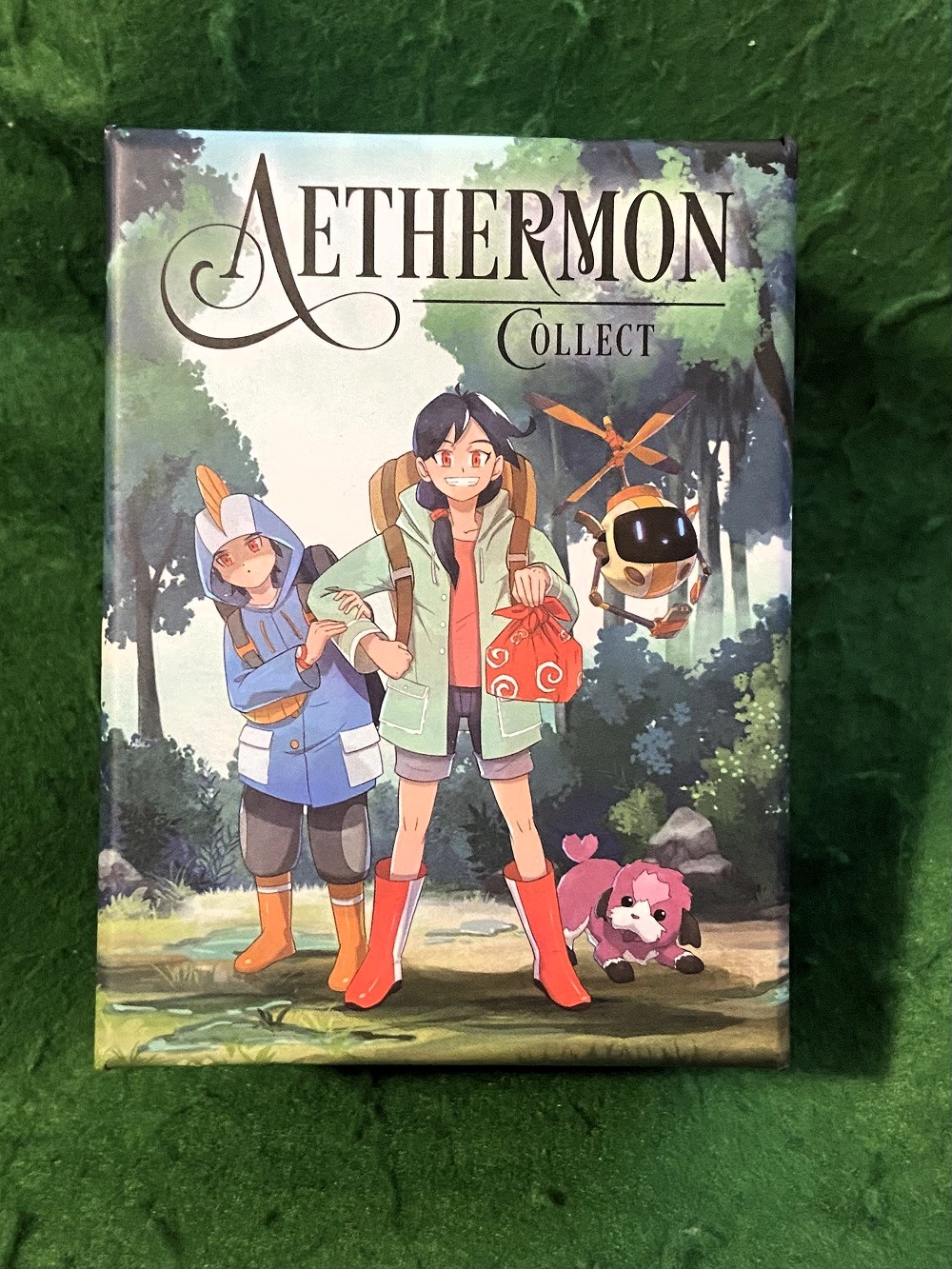
This is the box.
This is what’s inside the box.

Unlike other card-driven set-collection games, everything you need to play Aethermon: Collect is in this box. For some parents who are hesitant to join the other games, this is going to be a huge relief.
- 48x Aethermon cards
- 12x Artefact cards
- 14x Rule cards
- 1x 5cm acrylic player token
- 1x small neat box to hold it all (have tested it and can confirm it fits in my handbag)
Let’s start with the core element: the cards. These are good quality, clearly printed cards–around three-quarters (¾) the size of Pokémon cards. Now, I have big truck-o-Saurus hands, and I feel very comfortable holding these cards. No cramping or complaining. They are also a good size for younger kids. However, there is little need for holding the cards, so not a big issue (more on gameplay below). The Standard Pledge also comes with a pack of card sleeves which is a great idea (unfortunately, my review copy did not). To be fair, everything in the box is great quality, including the box.

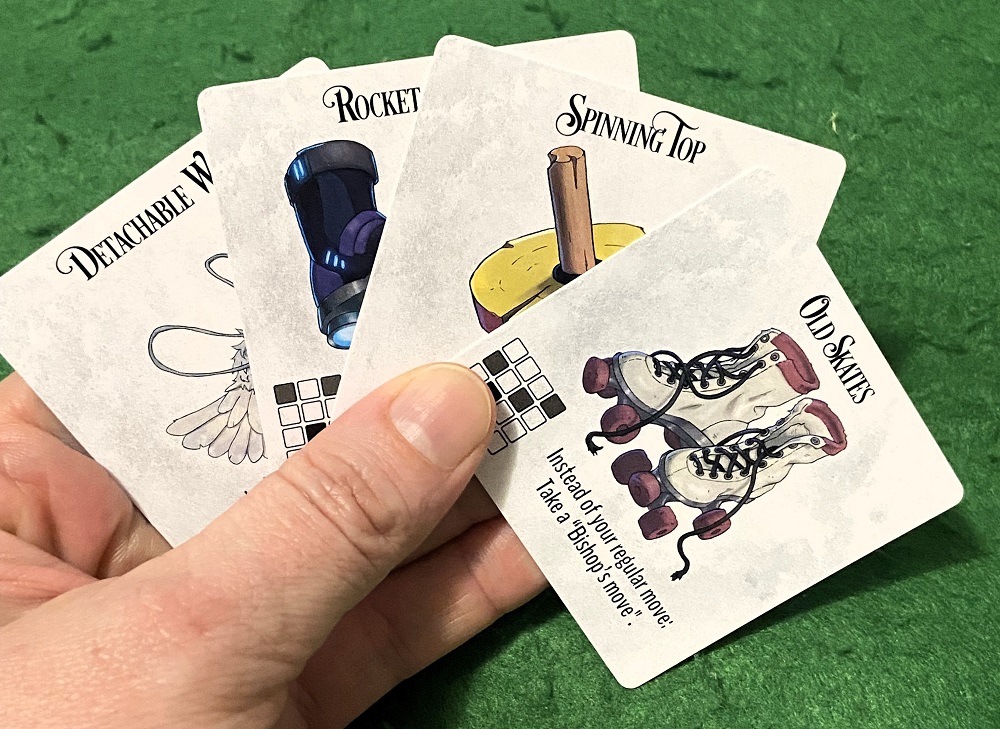
There are two types of cards in the deck: Aethermon and Artefacts. Aethermon are creatures you can collect to help you on your journey. Face up, the card will show the creature, its name and element, the point value, and any other Aethermon in its family/set. If you collect the whole set, the point value of the set is doubled. On the back of the Aethermon card is a quick description of the Aethermon, showing a bit of its character and skills. I love these details as part of the narrative and world-building.
There are also Artefacts to use during competitive play. Artefacts act as boosts or benefits during the game. Artefacts add a strong strategic feel to the game and should not be underestimated. Ever.
How to Play Aethermon: Collect
First, decide how many are playing and whether you are playing cooperatively or competitively. If you’re playing cooperatively, I admire your desire for peace, love, and happiness. Take out the Artefacts and stick with the cute-and-cuddly Aethermon.
If you’re playing competitively–Welcome to the family. Separate the Artefact cards from the Aethermon deck, and make yourself comfortable. Things could get messy.
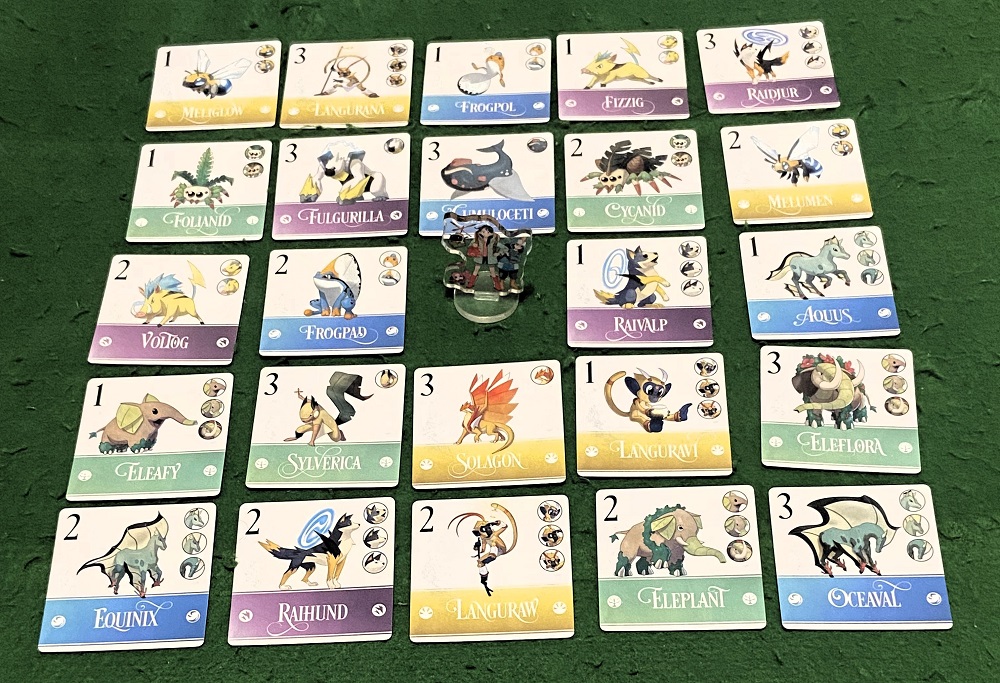
- Set-up: Shuffle the Aethermon deck, and then set up the cards in a grid face-up to match the number of players (leaving the centre square vacant).
- 2-players will have four (4) different elements in the deck with a 5×5 grid
- 3-players will have six (6) elements in a 6×6 grid
- 4-players will have eight (8) elements in a 7×7 grid
- If you’re playing competitively, draft the artefacts (if not, skip this part). Randomly divide the Artefacts into pairs face-up. Players will take turns choosing a pair of Artefacts for them to use during the game.
- Place the Token in the vacant position to start.
- Players take turns to move the Token any number of squares either horizontally or vertically within the Grid (like a Rook/Castle in Chess).
- If the player moves the Token onto an available Aethermon, the player removes the Aethermon from the grid and places it in their collection. This ends their turn.
- In co-op mode, any turn that does not collect an Aethermon ends the game. In competitive mode, the game ends after each player has had a consecutive turn without collecting Aethermon.
- When playing with 3 or 4-players cooperatively, you cannot collect an Aethermon if another player has an Aethermon of the same set. However, in competitive mode, the gloves are off, and you can do what you want–though I am not responsible for the consequences of your actions after the fact.
- At the end of the game, count the points on each card to determine the winner or to see if you beat your group PB.
Quick, Cute, and Plenty of Gameschooling Potential
This game is so simple, you can learn how to play AND teach someone else in the same amount of time it takes to read this review. No exaggeration. It’s the perfect game for keeping in your bag for random ‘waiting moments’: Airports, picnics, waiting for kids to finish music lessons, waiting for the Perseids Meteor Shower (yes, I am planning ahead). I love the small games you can take anywhere! We have three or four different games on rotation, and they save us a lot of tears (mostly mine).
If you’re looking to include this in your Gameschool collection, most of the benefits are what I consider passive or indirect.
- Narrative: Every Aethermon card has a description of the creature, revealing its personality or characteristics. They are great examples of creative writing, suitable to use as prompts for writing exercises.

- Math: Point scoring encourages basic arithmetic as well as comparing the most advantageous card to collect
- Science: Sets or families of Aethermon share physical features, showing a progression or evolution of characters. This would help with explaining biology and the evolution of certain species.
- Cooperative Play: I really don’t think we give enough credit to Alternative Dispute Resolution or ‘Negotiation Skills’. It is often seen as a ‘soft skill’, but it is definitely one of the top five skills you should learn before leaving school.
- Rule Bending: Artefact cards are used to bend the rules or change the circumstances for at least one move. This is another ‘life lesson’ that helps kids understand when rules need to be noted and when exceptions are okay. As a former lawyer, believe me when I say this is super-SUPER important.
Don’t be fooled by the simplicity of the gameplay. The developers have already included a few alternate Competitive Rules in the box, including Hidden Artefacts and Team-Ups. We also had a round where you must collect sets in their evolutionary order to receive TRIPLE points. Or players can only collect Aethermon featuring a colour they are wearing today. There is plenty of room for variation and growth within the game.

Join the Crowdfund for Aethermon: Collect
You have until the end of the month to join the crowdfunding efforts for Aethermon: Collect. Rest assured: it has already hit its target. They have also unlocked many stretch goals, including Solo Mode Rules, a campaign for 1-2 players, new Artefact cards, and an Adventurer’s Club e-Book. For a small box, it really does contain a huge amount of fun!
Thanks to the team at Aethermon Studios for providing a review copy! No money changed hands for this review – all views are my own, free and independent.
Score: 4 out of 5 Sleepy Plutursas (the true hero of the Aethermon)

Categories: Curriculum of Evil Gameschooling

Evil Genius Mum
Evil Genius Mum
- Taking over the world, one blog post at a time
 Evil Genius Mum
2 replies ›