Tears of the Kingdom was released almost two months ago, and it has already become a favourite in our family. Not a hard achievement, considering Breath of the Wild was our “Game of the Year” for 2017…and 2018, 2019, and 2020 (it was a tougher competition for 2021 and 2022, but BotW still gained plenty of gameplay). As a sequel, TotK had a pretty high benchmark to reach–and it did! There is plenty to rave about: the open-world play across three levels of exploration, the mindblowing ‘sandbox play’ with zonite creations, and the plentiful narrative with interwoven sidequests bringing the world of Hyrule together. However, none of us expected the grand salute to world history displayed through the visual world-building. BotW had touches of history, but there is so much more in TotK.

Flashback: Glimpses of World History in Breath of the Wild
To be clear, this is not simply the hopeful theorising of a history nerd. There are, in fact, intentional nods to world history scattered across BotW Hyrule. In 2017, Nintendo released “The Making of The Legend of Zelda: Breath of the Wild”, a 10-minute video featuring some of the inspiration in the game design. It included an explicit mention of the historic inspiration for the game’s art design. All of the ancient materials in BotW are inspired by the Jōmon period of Ancient Japan. BotW’s Art Director, Satoru Takizawa, noted how this particular era was relatively unknown outside Japan. The game embraced the concept of ancient civilisations, building on the sense of mystery and wonder.
The Jōmon period is the time between 14000 BCE and 300 BCE. There was a diverse hunter-gatherer existence that developed into an early agriculturalist lifestyle. Much of the history is found through pottery; the earliest examples were decorated by impressing cords into the surface of wet clay. The Jomon period is also known for its beautiful jewellery, such as the Magatama here. Look familiar?
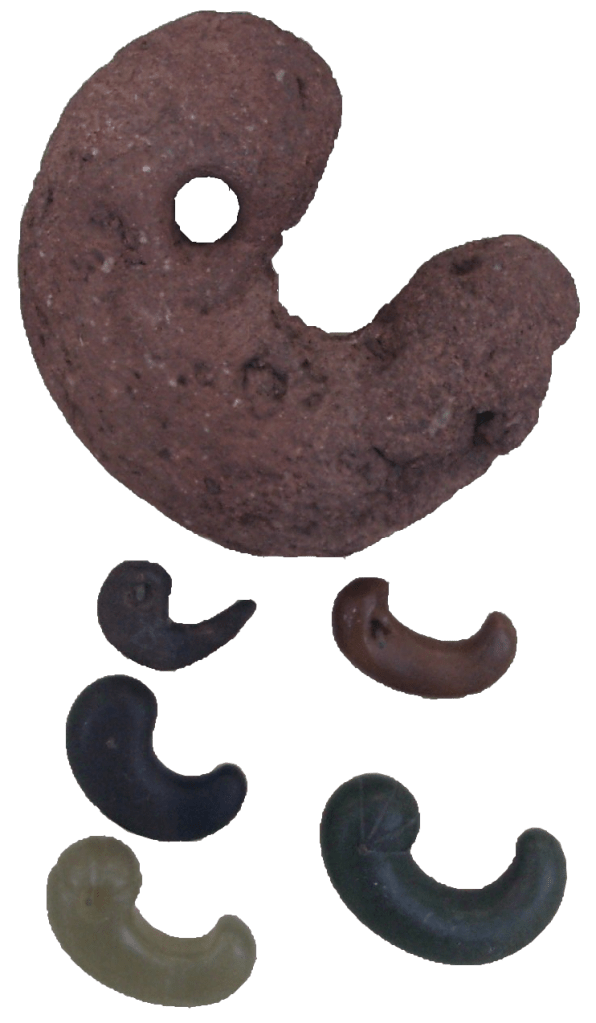
To add to the history nerdiness, some fans have also noted signs of Mesoamerican inspiration. Surprisingly, the Jōmon period in Japan is often compared to the Valdivia culture in Ecuador due to the similar cultural complexity within a primarily hunter-gather context. I love how the art design in BotW has decided to just dive into this relationship head-on, featuring Valdivian designs in the Faron region. Check out this Parrot mortar found in the Valdivian region.

Tears of the Kingdom and the World Tour of History
BotW had a few more global history references, but TotK definitely took it a step further. It’s almost like the Art Design team saw the Valdivian culture and said, 私の酒を握って (translation: Hold my sake). TotK features even more Mesoamerican art across Hyrule. The geoglyphs on the hills are similar to the Nazca lines found in the desert of Southern Peru. Multiple shrines feature the Sun motif, a strong symbol of faith in the Inca Empire. And let’s not forget the artistic style of the statues throughout the Faron region.
However, TotK history love is not limited to Mesoamerica. The thing about history nerds is that when we see one reference, we can’t help looking for more. And recently, I discovered some surprising tidbits where I least expected to do so.
Sticky Lizards: Diplocaulus (Amphibian)
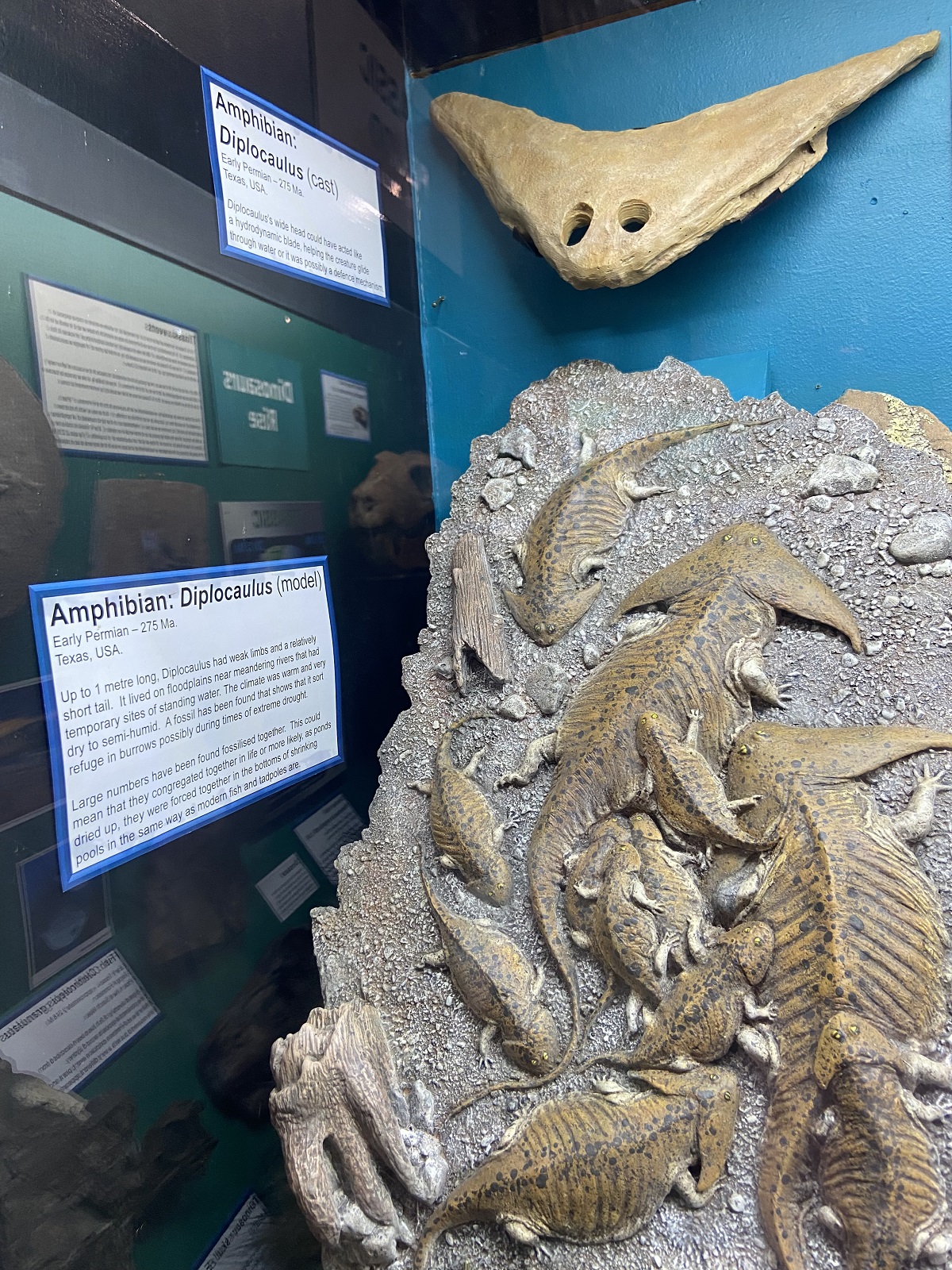
This extinct amphibian lived during the Permian Age, approximately 275 Ma (that’s 275 million years ago). They could grow up to 1m long but had weak limbs with relatively short tails. Most noticeable is their head shape, with long protrusions or horns at the rear of the skull. It gives them a boomerang-shaped head, almost exactly like the Sticky Lizards you find in caves throughout Hyrule in TotK. The diplocaulus lived on floodplains near rivers, with fossils found congregated together in areas where the water has likely dried up. This particular fossil image was spotted at the National Dinosaur Museum in Canberra (Australia), with the original fossil discovered in Texas (USA).
Zonite v Brochantite
Always looking for the shiny, we spotted these samples of Brochantite on display at Geoscience in Canberra (Australia). Brochantite is a copper sulphate mineral formed in arid climates or in rapidly oxidising copper sulphide deposits. The crystals of brochantite are found in a range of colours, from emerald green to black-green and blue-green. It is often associated with malachite, azurite, and chrysocolla. You may even recognise brochantite as a common corrosion product on bronze sculptures in urban areas when it reacts with atmospheric sulphur dioxide. The colour of both the brochantite seen here is reminiscent of the Zonite mined throughout TotK. Whether or not brochantite warrants enough conductivity to the same levels as Zonite will require further investigation.

Astarte as a Sage in TotK
The Sages of TotK are gifted with god-like powers. Is it any wonder they may have been inspired by images of gods in other cultures? At the Chau Chak Wing Museum at the University of Sydney (Australia), we recently found this magnificent terracotta figure. The female figure has a bird-like head adorned with circles, very similar to the masks of the ancient sages in TotK. It belongs to a series of figurines heavily influenced by northern Syrian figures depicting the goddess Astarte in about 2000-1000 BCE. The shape of the figure is akin to fertility goddesses of the time period: Astarte, Ishtar, and Aphrodite–who is said to have been borne straight out of the waters near Cyprus, where these figurines are most commonly found. Perhaps, given time, we may find a new Sage in Hyrule.

Norse Airships
Our final history stop is in Denmark and Norway, where we shall take up a Viking ship and sail up into the icy clouds to challenge the Scourge of the Wind Temple…Wait, that’s not what happens. However, if you take a good look at the Stormwind Ark (AKA The Wind Temple in TotK), it’s hard to miss the strong resemblance with Viking ships from long ago. I recently built the 3-in-1 LEGO version of a Viking Ship and instantly saw the similarities. The long-boat structure with paddles out the side and the placement of the figurehead at the front are all in the style of a Norse Viking Ship. It’s also a nice touch when you spot the Aurora Borealis in the Hebra region.

Can We Use TotK for Video Gameschooling?
There’s enough info here to use TotK as a starting point for any history studies. You probably can’t use the game as the sole educational tool in the syllabus (darn it), but this game works well as a launch pad for great discussions. The key here is to start the conversation. What would sticky lizards feed on in their cave habitats? Can copper sulphate minerals conduct electricity to power Zonite creations? How did Norse Viking ships survive severe weather storms? All of these little questions can lead you down the merry path of learning something new.
I was initially unsure if the game developers could top the magnificence of Breath of the Wild. Since playing Tears of the Kingdom, I believe the sequel game is a brilliant step beyond BotW. But I also believe the extra details in TotK allow me to revisit BotW as a separate game. The narratives of both are separate, even if they do build on each other. Using world history facts to enhance the visual environment gives me a deeper connection and investment with the game. I’m excited to learn more and then look for more Hyrule in our own world. And that just inspires me to come back and play more Zelda as well.
If you spot any ‘real world’ Legend of Zelda references, let me know in the comments below!
Categories: Curriculum of Evil Gameschooling video games

Evil Genius Mum
Evil Genius Mum
- Taking over the world, one blog post at a time
 Evil Genius Mum
Minion Musings: